
July 30, 2026
Visibility & SEO Strategy & value
GEO vs. SEO: What is the difference, and how do you become visible in both Google and AI?
GEO – Generative Engine Optimization – is often called the successor to SEO. But GEO does not replace SEO. Here is the difference, the shared foundation, and a practical approach to becoming visible in both classic search results and AI answers.
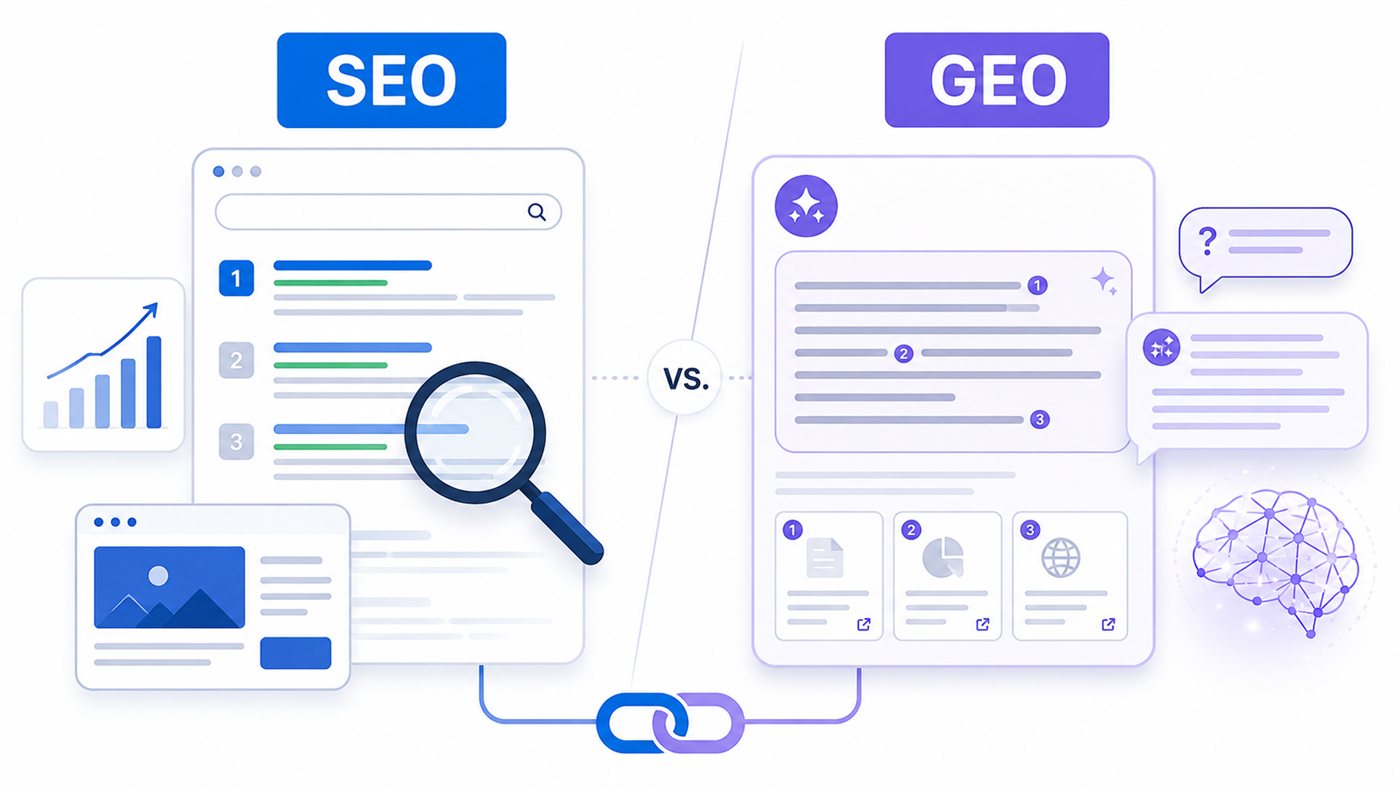
When a potential customer needs to find a supplier, a product, or an answer, the journey no longer necessarily starts with ten blue links in Google. Some ask ChatGPT. Others use Google and meet an AI-generated overview at the top of the page. Some search in Bing or Copilot, while others still click through the classic organic search results.
This has created great interest in GEO – Generative Engine Optimization. The term is often presented as the successor to SEO, but that description is misleading. GEO does not replace SEO, and SEO has not become an outdated discipline overnight.
In practice, the two areas overlap to a high degree. A website that is technically sound, professionally credible, and helps its visitors with concrete questions has, as a starting point, better prerequisites for becoming visible both in traditional search results and in AI-generated answers.
There are differences, though. SEO works with, among other things, rankings, clicks, and organic traffic. GEO pays greater attention to whether the company, the brand, or the content is understood, mentioned, and used as a source in generative answers. Therefore both content format, analysis, and measurement change slightly.
This guide reviews what SEO and GEO mean, where they overlap, what is genuinely new, and how you work systematically with both over time.
What is SEO?
SEO stands for Search Engine Optimization. It covers the ongoing work of making a website easier to find, understand, and assess for search engines like Google and Bing.
The goal is not simply to get “more traffic”. Good SEO is about being found by the right people at the times when the company’s content, products, or services can actually help them.
SEO typically covers several areas:
Technical SEO is about whether search engines can crawl, render, and index the website correctly. It includes, among other things, internal links, sitemap, URL structure, mobile rendering, speed, canonical tags, status codes, and the handling of JavaScript.
The content work is about understanding users’ search intent and creating pages that answer it better than the alternatives. It can be service pages, product texts, guides, cases, comparisons, and articles.
On-page SEO includes, among other things, page titles, headings, meta descriptions, image captions, internal links, and a clear information structure.
Authority and mentions concern the signals that exist outside the website. Relevant links, professional mentions, reviews, business profiles, and a consistent presence online can help substantiate who the company is and what experience it has.
SEO is not a task you do once and can then forget. Search behaviour changes, competitors publish new content, the technology on the website is updated, and the company’s own products and services evolve. Therefore SEO requires ongoing analysis, maintenance, and improvement.
What is GEO?
GEO stands for Generative Engine Optimization. The term is used for the work of increasing the likelihood that a company or its content is found, understood, mentioned, and possibly cited in AI-generated answers.
That can be answers in, for example, ChatGPT Search, Microsoft Copilot, Google AI Overviews, Google AI Mode, or other services that combine generative language models with information from the web.
On a traditional search results page, the user typically chooses between a number of links. In a generative search result, the system gathers information from several sources and formulates a direct answer. Links and source references may still be present, but the user’s first encounter with the content often happens inside the answer itself.
This means that visibility is not only about ranking number one for a particular keyword. It can also be about:
- being mentioned as a relevant supplier or expert
- having a page used as a source for an explanation
- getting a product or service included in a comparison
- having the company’s facts reproduced correctly
- being among the sources the user can click through to
- influencing the understanding the AI system forms of a topic or a company
GEO is also sometimes called AEO, LLMO, or AI search optimization. The terms are not used entirely consistently across the industry, and there is not yet one common, officially established discipline with a universal set of ranking factors. It is therefore sensible to be sceptical of very precise recipes for what “AI always prefers”.
The biggest misconception: SEO is not dead
Some of the marketing around GEO builds on the narrative that everything has changed and that classic SEO no longer works. That is a good headline, but a poor description of reality.
Google itself states that the fundamental SEO principles still apply to AI Overviews and AI Mode. A page must still be crawlable and indexable, and there is no special GEO markup or secret AI schema that automatically grants visibility.
That makes good sense. Generative search experiences still have to find relevant information somewhere. When an AI service retrieves current information from the web, the process still depends on the content being accessible, understandable, trustworthy, and relevant.
Therefore GEO is rarely a separate project that should be placed in an entirely different department than SEO. It is rather an extension of the work with digital visibility.
A strong technical and content-related SEO platform is the foundation. GEO adds further attention to, among other things, clear answers, topic coverage, entities, source value, brand consistency, and visibility across platforms.
GEO vs. SEO: The short difference
SEO and GEO both try to make relevant content visible, but they work toward different forms of presentation.
With SEO, the typical goal is that a page is shown high in the search results and attracts a relevant click.
With GEO, the goal is also that the content is found, but in addition that it can meaningfully be part of a generated answer – as a source, reference, recommendation, explanation, or factual basis.
SEO is often measured with rankings, impressions, clicks, organic traffic, conversions, and revenue.
GEO can additionally be measured with brand mentions, source citations, visibility in selected AI answers, referral traffic from AI services, and the quality of the answers in which the company appears.
SEO often takes its starting point in keywords, search intents, and concrete search results pages.
GEO also requires an understanding of the questions, comparisons, and sub-questions that a generative system can use when it assembles an answer. Google describes, for example, how AI features can use “query fan-out” and perform several related searches across sub-topics.
It is a real difference, but not a complete break with SEO. A thorough content universe that covers a topic and its natural sub-questions has long been good SEO. GEO simply makes the value of this approach even clearer.
What SEO and GEO have in common
By far the greatest part of the good work benefits both disciplines.
The content must be useful
A text does not become good because it mentions a keyword many times or uses the right technical terms. It must help a human understand something, make a decision, or solve a problem.
That means, among other things, that the content must be concrete, precise, and sufficiently comprehensive. It must answer what the headline promises, and it should add something more than a rewrite of the first search results.
The technology must work
If important content is hidden from crawlers, the page cannot be indexed, or the website is full of duplicates and broken internal links, both traditional and AI-based visibility becomes more difficult.
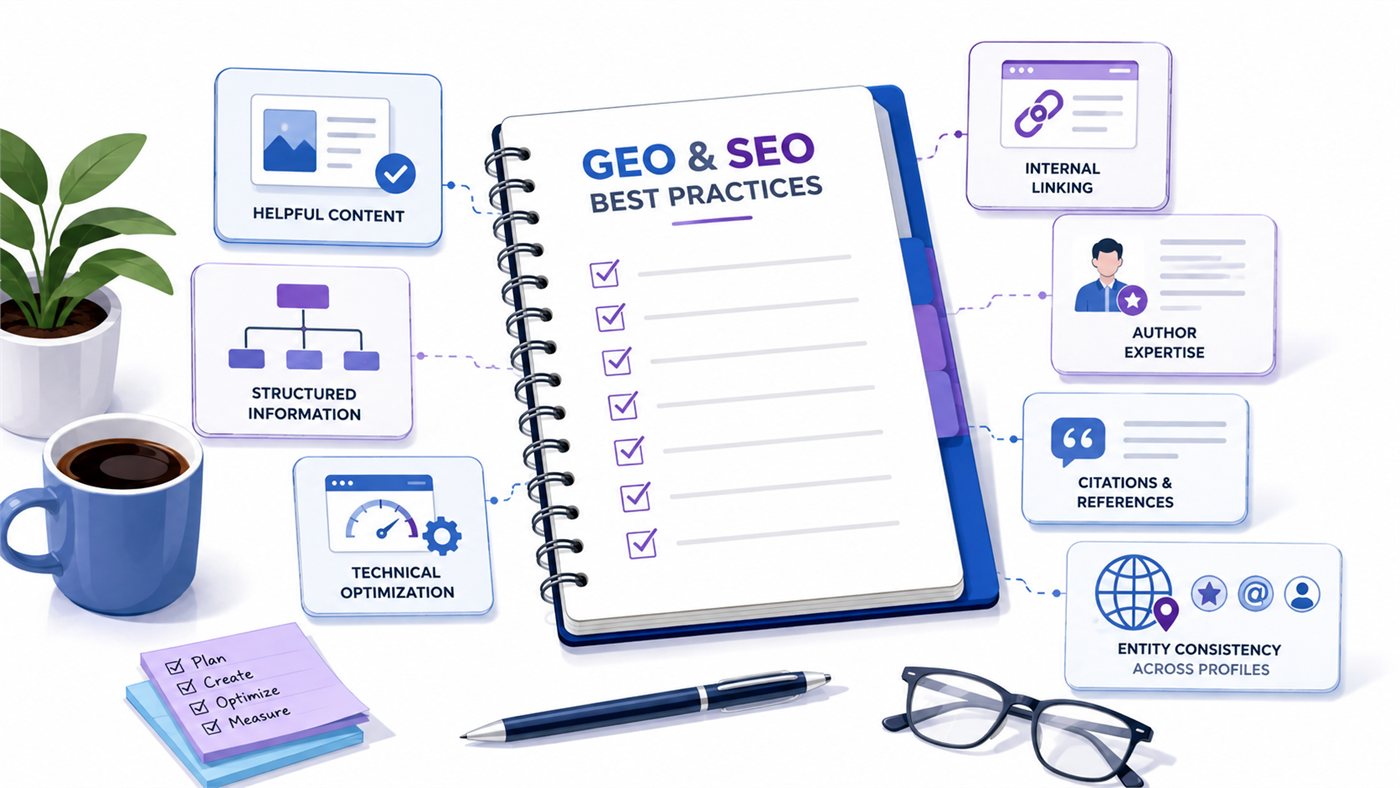
Good technical SEO is therefore also GEO best practice. That includes crawlability, internal link structure, clear URLs, fast and stable rendering, as well as important content in accessible text form.
Credibility must be documentable
It is easy to write that you are an expert. It is more valuable to show it.
Cases, author information, concrete experience, images from your own work, customer references, clear contact details, prices, methods, and original examples make the content more usable for the reader. At the same time, it gives search and AI systems better material for understanding the company.
The content must be maintained
A guide can be excellent when it is published and misleading two years later. Prices, legislation, software, products, and recommendations change.
Ongoing updating is therefore not something that only belongs to GEO. It is just as important in SEO. An update should, however, be real. There is no value in merely changing the date at the top of the page if the content is unchanged or outdated.
So what does GEO change in practice?
If the foundation is the same, it is reasonable to ask whether GEO is merely a new name for SEO. The answer is both yes and no.
Some GEO advice is well-known SEO in new packaging. Nevertheless, the user experience and the way the content is used are different enough that some priorities should be adjusted.
Write answers that can stand alone
AI-generated answers are often assembled from smaller pieces of information from several sources. It is therefore an advantage when key passages are clear and can be understood without reading the whole page from the beginning.
This does not mean that all texts should be written as a series of mechanical FAQ answers. It means that definitions, conclusions, and recommendations should be clear.
A section with the heading “What does a WooCommerce webshop cost?” should, for example, begin with a usable answer and then explain the factors that affect the price. The reader should not have to go through 500 words of general background before the question is answered.
Cover the topic – not only the exact wording
A user can ask Google: “What does a webshop cost?” In ChatGPT, the same user might write: “I run a smaller physical shop and want to sell about 300 products online. What should I budget for, and which hidden costs should I know about?”
The second question contains several dimensions: platform, number of products, payment, shipping, operation, integration, support, and ongoing marketing.
Good GEO content covers the natural sub-questions the user needs for the decision. It is not an encouragement to create 50 almost identical pages for every possible prompt. It is an encouragement to create coherent, deep, and usable content.
Make the company unambiguous
AI systems do not only try to understand a single page. They also try to understand people, companies, products, places, and the relationships between them.
Therefore information about the company should be consistent. Name, address, services, areas of expertise, contact details, and descriptions should not contradict each other on the website, business profiles, industry portals, and social profiles.
This is often called entity optimization. In practice it is about making it easy to answer questions like: Who is the company? What does it offer? Where does it work? What experience can it document? And how does it differ from others?
Create content worth citing
Generic phrasings are easy to replace. Original information is harder to get around.
It can be your own research, calculations, cases, before-and-after examples, concrete price ranges, experience from projects, comparisons, or a well-documented method.
An article that merely repeats that “a fast website is important” adds limited value. An article that shows which concrete problems you found on 20 WooCommerce webshops, how they were solved, and what effect the changes had, is far more interesting for both people and systems looking for usable sources.
Think beyond the single click
In classic SEO, the click has often been the clearest goal. In generative answers, the user can get a large part of the answer without visiting the website.
This does not mean the visibility is worthless. A credible mention can influence which suppliers a potential customer later investigates. But it means that the content must give the user a reason to click through.
That can be access to a calculator, a complete checklist, an in-depth case, a tool, a template, concrete prices, or a service that cannot be delivered directly in the AI answer.
Best practice for SEO and GEO
The best strategy is not to produce one version of the content for Google and another for ChatGPT. Instead, build content that works for people, is technically accessible, and gives the systems clear signals.
1. Start with the customer’s real questions
Keyword data is useful, but it is not the whole picture. Also use questions from sales meetings, support requests, emails, reviews, and customer conversations.
It is often here that you find the phrasings and concerns that do not appear clearly in a keyword tool.
2. Match the actual intent
A person who searches “WooCommerce price” may be looking for the plugin price, the price of a finished webshop, or the ongoing operating costs. A strong page clarifies the intent and helps the user onward.
Avoid optimizing a page for a keyword if the page actually solves a different problem.
3. Use a clear structure
A logical main heading, descriptive subheadings, and short, coherent paragraphs make the text easier to skim and understand.
Lists and tables are useful when they make complex information more manageable. They should not be used mechanically just to “feed AI”. A good structure is first and foremost a service to the reader.
4. Answer directly – and explain afterward
When a section asks a concrete question, the answer should come early. Then you can unfold nuances, exceptions, and examples.
It benefits users who want a quick answer, without punishing those who need the full explanation.
5. Document experience and expertise
Use named authors, cases, images, method descriptions, and concrete examples. Don’t just tell people that the company has experience – show what the experience consists of.
This is especially important in areas where wrong advice can cost the reader time or money.
6. Substantiate facts and keep them current
Link to relevant primary sources when the article builds on legislation, official guidelines, statistics, or technical documentation.
At regular intervals, review the pages where changes can make the recommendations wrong. That applies, for example, to prices, software versions, rules, integrations, and platform features.
7. Strengthen internal coherence
A single article should not stand in isolation. Link to relevant service pages, cases, and in-depth articles, so that both users and crawlers can see the connection between the topics.
A well-developed topic area is often stronger than a collection of random blog posts.
8. Use structured data correctly
Schema.org markup can help search engines understand certain content types, but structured data must match the visible content.
There is no special GEO schema that guarantees inclusion in AI answers. Therefore use markup where it makes professional and technical sense – not as decoration.
9. Ensure access for relevant crawlers
If you want to be able to appear in Google, Bing, or ChatGPT Search, the relevant crawlers must be able to access the content.
OpenAI states, for example, that OAI-SearchBot must not be blocked if the page’s content is to be able to appear in summaries and excerpts in ChatGPT Search. It is a technical check that should be reviewed together with robots.txt, noindex tags, and any firewall or CDN rules.
10. Follow the results and adjust
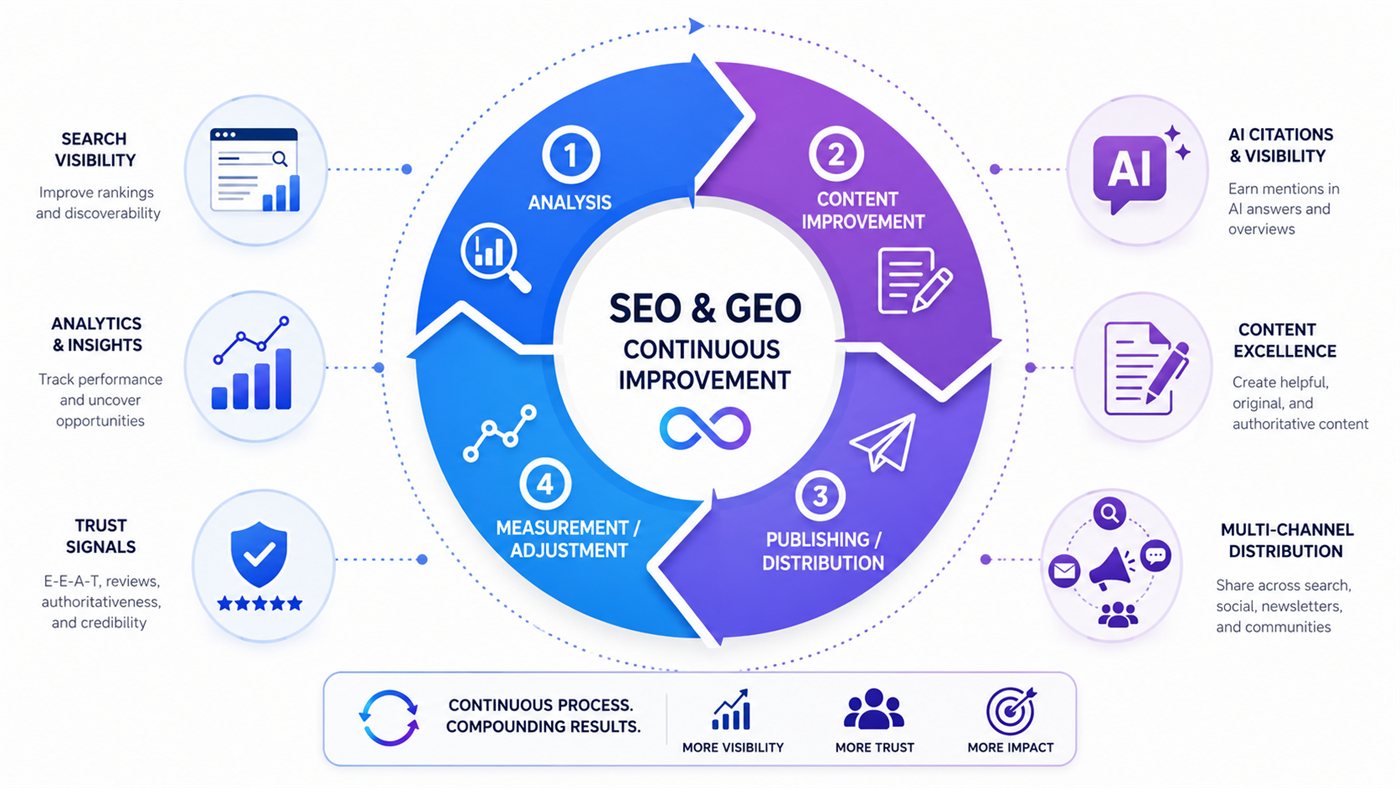
SEO and GEO are hypothesis-driven work. You publish, measure, learn, and improve.
If a page gets many impressions but few clicks, the title and angle may be the problem. If it attracts traffic without inquiries, the content may match the wrong intent. If the company is never mentioned in relevant AI answers, there may be a lack of authority, precision, topic coverage, or consistent information across the web.
SEO and GEO as an ongoing process
It is tempting to treat visibility as a project with an end date: The website is optimized, the articles are written, and then the task is finished.
That is not how either SEO or GEO works in practice.
A solid working rhythm can be divided into four recurring activities.
Monitoring
Track technical errors, indexing, visibility, traffic, conversions, and the most important landing pages. Also keep an eye on whether the brand appears correctly in relevant AI answers, and whether referral traffic from AI platforms changes.
Google currently gathers traffic from AI Overviews and AI Mode in the regular web report in Search Console, while Bing has introduced a separate AI Performance view in Bing Webmaster Tools. The measurement options are therefore evolving continuously and are not yet the same across platforms.
Maintenance
Fix dead links, outdated information, technical errors, and pages that compete with each other. Update company information, product data, prices, and documentation when something changes.
Maintenance is also about protecting what already works. A redesign, migration, or change in the URL structure can cost visibility if it is carried out without SEO control.
Improvement
Expand pages where users are missing answers. Sharpen introductions, add concrete examples, improve internal links, and consolidate thin or overlapping pages.
It is often more valuable to improve a good existing page than to publish yet another generic article.
Development
New products, customer problems, and market changes create new content needs. Here the company should publish new content when there is something useful to say – not merely to hit an artificial publishing frequency.
A practical monthly rhythm can, for example, be:
- review technical errors and indexing
- check the development on the most important pages and search intents
- update at least one existing, business-critical page
- publish new content when there is a documented need
- test key questions in relevant AI platforms
- record mentions, source references, and referral traffic
- assess leads and sales – not only impressions and clicks
- plan the next improvement based on data and customers’ actual questions
How often the work should be done depends on the size of the website, the industry, and the pace of change. A smaller local business does not need a daily GEO dashboard. A webshop with thousands of products, changing stock, and international traffic requires an entirely different level of monitoring.
How do you measure SEO?
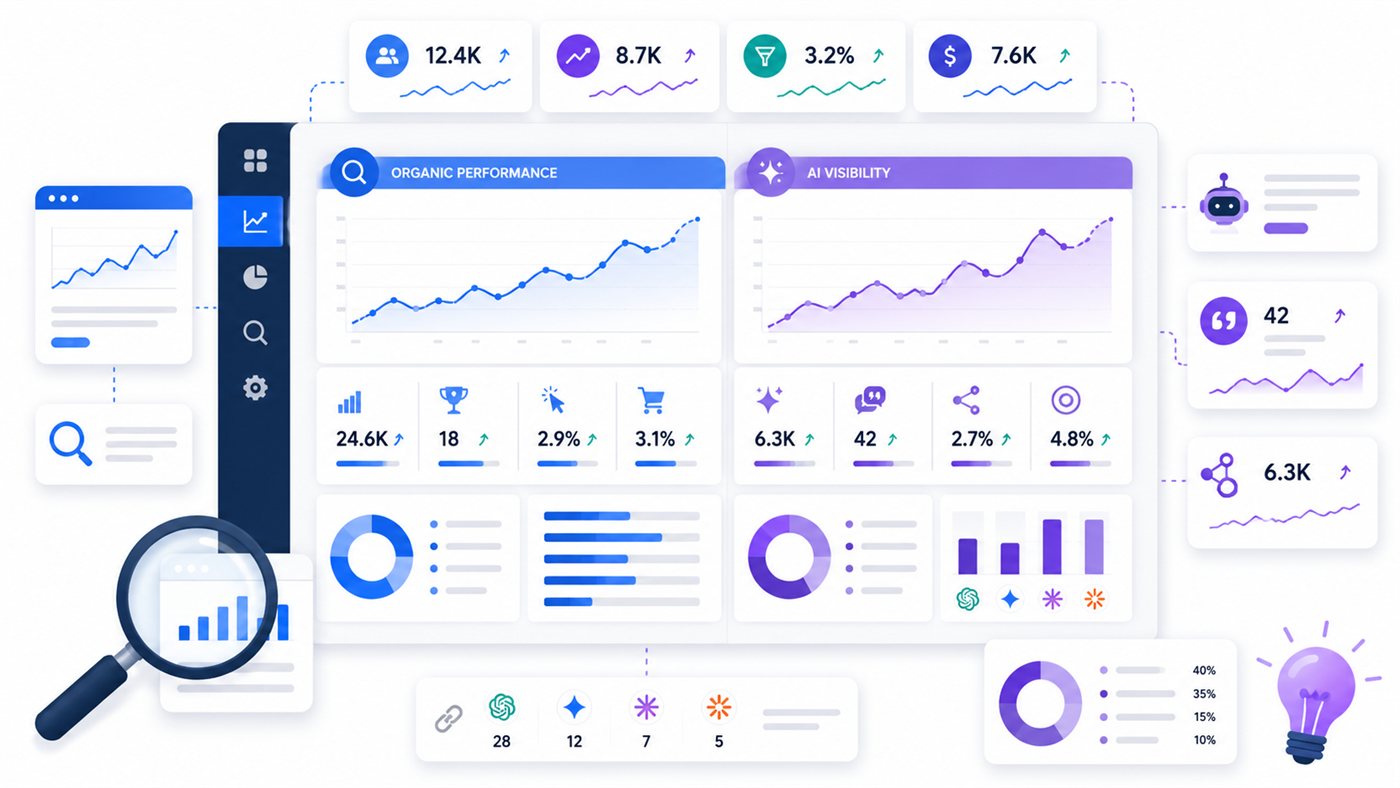
SEO should be measured based on the business’s goals, not only the ranking on individual keywords.
Relevant measurements can be:
- organic impressions and clicks
- development on important topics and landing pages
- share of relevant, non-branded traffic
- contact forms, phone calls, and quote requests
- sales and revenue from organic traffic
- the quality of the visitors
- indexing problems and technical stability
- links and relevant mentions
- the development in local search results
Rankings are still useful as an indicator, but they do not tell the whole story. Search results vary by geography, device, history, and result type, and a first place on an irrelevant keyword can be worth less than a fifth place on a question with strong purchase intent.
How do you measure GEO?
GEO is harder to measure precisely, because AI answers can vary between platforms, users, and phrasings. An answer can change from day to day, and not all services show the same data.
Therefore you should work with a fixed, representative set of questions rather than random single tests.
Measure, for example:
- whether the company is mentioned on relevant prompts
- whether the mention is correct, positive, and contextual
- which of the company’s pages are cited
- which competing sources are used
- whether source references drive traffic
- whether AI referrals convert
- whether the company’s products or services are included in relevant comparisons
- whether facts about the brand are consistent
Avoid treating a single ChatGPT conversation as an objective ranking result. Test several phrasings, document date and platform, and look for patterns over time.
It is also important to accept that part of the value can be difficult to attribute. A potential customer can encounter the company’s name in an AI answer, search directly for the brand later, and only then send an inquiry.
Common mistakes in the work with GEO
Forgetting the SEO foundation
It makes limited sense to optimize phrasings for AI if the page cannot be crawled, is slow, lacks internal links, or is not indexed.
Mass-producing question pages
It can seem logical to create a page for every conceivable prompt. The result is often many thin, overlapping pages without independent value.
Google warns directly against scaled production that primarily aims to manipulate search results or generative answers. Instead, cover the topic properly and organize the content logically.
Writing unnaturally for machines
Texts full of rigid definitions, artificial questions, and repetitions rarely turn out good for the reader. An AI-friendly text should still feel like something a human has written for another human.
Believing that a tool can guarantee citations
GEO tools can help with monitoring and analysis, but no external supplier can guarantee that a particular AI platform will use a particular page as a source.
Measuring mentions without business value
Being mentioned in many AI answers is not automatically valuable. The visibility must occur in relevant contexts and preferably among people who may need the company’s solution.
Forgetting the brand outside your own website
If the website describes the company in one way, while the company’s other profiles are outdated or contradict it, it becomes harder to form a clear picture of the brand.
Should you invest in GEO now?
Yes – but not necessarily by creating a large, separate GEO project.
Start by ensuring that the existing SEO work is healthy. Review the technology, the most important landing pages, the company’s professional documentation, and the coherence between the website and external profiles.
Then expand the analysis:
Which questions do customers ask in generative services? Is the company mentioned? Which sources are used? Do you yourself have content that is better, more concrete, or more up to date? Is there a good reason for the user to visit your website after reading an AI answer?
For many small and medium-sized businesses, the right solution will be a combined visibility strategy where SEO and GEO are not treated as rivals. Technology, content, authority, user experience, and measurement are connected.
Conclusion: GEO extends SEO – it does not replace it
SEO is about being found and chosen in search engines. GEO is about being found, understood, and used in generative search experiences.
The difference is real, because the presentation, user behaviour, and some of the measurements change. But the foundation is very much the same: technical access, helpful content, clear expertise, trustworthy information, and ongoing improvement.
SEO is not a one-time optimization. GEO is not a one-time optimization either. Both require that you follow the development, maintain the content, learn from data, and adapt the effort when customers, competitors, platforms, and the company’s own offerings change.
The strongest strategy is therefore not to chase every new term or try to write for an unknown algorithm. It is to build the best, most trustworthy, and most usable digital source within the topics your company actually works with.
Shall we look at your visibility?
If you need to have your website’s visibility assessed in both classic search results and AI-based search, I can help with a practical review of technology, content, structure, and the most important opportunities for improvement.
Sources and further reading
- Google Search Central – AI features and your website
- Google Search Central – Optimizing your website for generative AI features on Google Search
- Google Search Central – Creating helpful, reliable, people-first content
- OpenAI – Publishers and Developers (FAQ)
- Microsoft Bing – AI Performance in Bing Webmaster Tools