
Service
Websites
Professional websites you own — built to make it easy for the right customers to understand what you offer and what to do next.
A website should not just look decent. It should make it easy for the right customers to understand what you offer, why they should choose you, and what to do next.
I help businesses, sole traders, associations, and organisations get new websites built or have solutions redesigned that no longer fit the business. The work does not begin with colours and buttons, but with the purpose: who should the site speak to? Which questions should it answer? Which pages and features are necessary? And how should it support your sales, communication, or daily work?
You get a solution you own and can take with you. There is no multi-year lock-in, no hidden rental agreement, and no salesperson between you and the person who actually builds the website. Scope, responsibility, and price are described in advance, so you know what you are buying.
I work mainly with WordPress, but the platform is chosen based on the task. The goal is not to force unnecessary features into the solution. The goal is a fast, clear, and maintainable website that is easy for both visitors and you to use.
Do you need a new website?
Tell me briefly about your business, your current solution, and what you would like to achieve. Then we will have a concrete talk about needs, options, and a realistic next step.
What can I help with?
New business website
A complete website built from scratch with structure, design, content, forms, mobile view, and a technical foundation that is easy to work on further.
Redesign of an existing website
A new version of a website that has become outdated, unmanageable, slow, or no longer fits the business's services and audience.
Structure and user journey
Help deciding which pages there should be, how they connect, and how the visitor is naturally led towards contact, booking, purchase, or another action.
Text and content structure
Sparring on messages, headings, page texts, FAQ, cases, and calls to action. The content must be understandable for the customer and at the same time give search engines and AI services a clear picture of the business.
SEO foundation
A technical and editorial foundation with, among other things, page titles, meta descriptions, heading structure, internal links, mobile friendliness, speed, and the option to continue SEO work.
Forms and features
Contact forms, newsletter sign-up, booking requests, documents, membership areas, or other relevant features — but only when they actually support the task.
Handover and training
When the site is finished, you get a walkthrough of the solution and the ability to change text, images, and ordinary content yourself.
Hosting and ongoing operations
After launch you can choose hosting and maintenance yourself. I offer managed hosting and service agreements, but the solution is not locked to me.
The important things are agreed in advance
- You know what is to be delivered
- You know the price or how it is calculated
- You know who provides content and material
- You know how many rounds of proofing are included
- You know which features and integrations are included
- You know what happens after launch
- You own the solution, the content, and the data
For larger tasks I draw up a SOW — Statement of Work — that describes the deliverable, the responsibility, the timeline, the price, and the most important limitations. It is not paperwork for its own sake. It is a practical way to avoid different expectations before the work begins.
A good website begins with a clear purpose
We do not need to know the finished design from the start. The most important thing is to understand the business, the audience, and the problem the website should solve.
What characterises a good business website?
A good business website makes it easy for the visitor to understand the business. It clearly explains what you offer, who it is relevant for, and how to proceed. That sounds simple, but many websites fail exactly here. They may contain nice images and general phrases, but leave the visitor with more questions than answers.
A website should therefore be assessed on more than its visual expression. Design matters, because it affects credibility, readability, and user experience. But the design must support the message. If the most important information is hidden behind animations, unclear menu items, or long blocks of text, a nice look does not help much.
The good website typically has a clear front page, clear service pages, an understandable navigation, and relevant ways to get in touch. It explains not only what the business does, but also how the collaboration works, what the customer can expect, and what sets the business apart from the alternatives.
That does not mean every website has to be large. A smaller business can often manage with a compact solution if the few pages are well developed. A larger organisation may need several entry points, audiences, and features. The scope should match the business and the tasks the website is to solve.
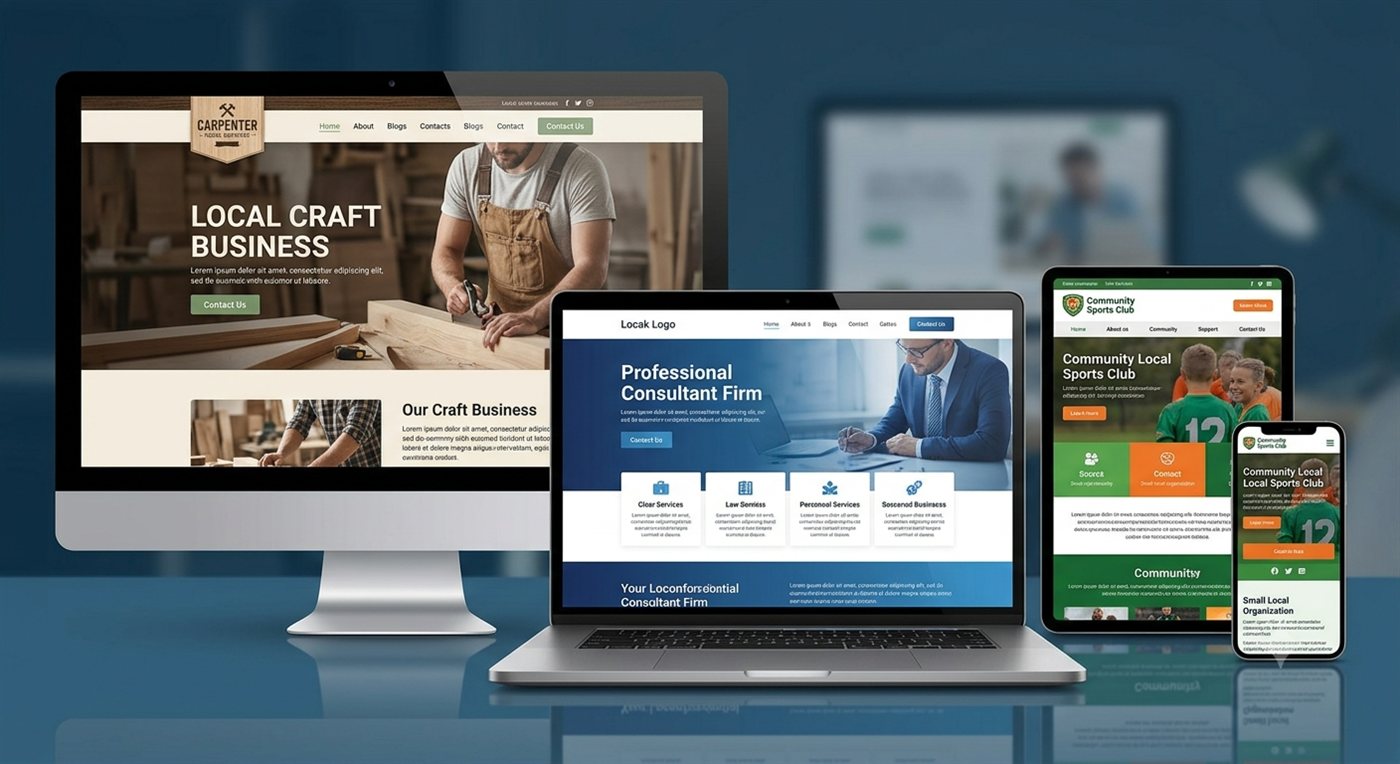
A website must be built for a specific audience
A common mistake is trying to write to everyone. The result is often a general message that no one feels directly addressed by. Before we build the site, we should therefore agree on who is most important.
It can be local private customers, businesses within a particular industry, associations, partners, or candidates for open positions. A business can have several audiences, but they do not necessarily need the same message.
When the audience is clear, it becomes easier to decide:
- Which questions the site should answer
- Which language should be used
- Which cases and examples are relevant
- Which objections the site should handle
- Which action is most important
- How much professional or technical explanation is needed
A craft business's customers, for example, often need to see areas of work, geographical area, images of previous jobs, and a simple way to get a quote. A consultancy may have a greater need to explain method, experience, specialities, and way of working. An association may first and foremost need to make information, membership, and events easy to find.
So the site should not be built from a standard package alone. A standardised process can be useful, but structure and content should start from the specific business.

A website's structure matters more than many think
The structure determines how the content is organised, and how easy it is for visitors and search engines to understand the site. If all services are gathered on one long page, it can be hard to create a clear message around each service. If, conversely, many almost identical pages are created, the site can become unmanageable and create overlap.
A typical business website can, among other things, consist of:
- Front page
- About the business
- A separate page for each important service
- Cases or references
- Knowledge, news, or articles
- Contact
- Privacy policy and other necessary legal pages
It is not a fixed template. Some businesses need prices, employee profiles, certifications, booking, downloads, or several location pages. Others do not.
The structure should also support internal links. An article can link to the relevant service. A service page can link to a case. A case can link to contact or a related solution. That way the website becomes more usable, and it becomes easier to understand the connection between the business's expertise and offerings.
The front page must explain the business quickly
The front page is not necessarily the first page all visitors see. Many arrive directly on a service page from Google or via a link. But the front page is still central, because it gathers the business's most important message.
A good front page should normally do the following:
- Explain the business's core service
- Say who the service is for
- Make it clear what the next step is
- Give access to the most important service pages
- Create credibility through experience, cases, or concrete information
- Answer the most common objections
The front page does not necessarily have to tell everything. It should give the visitor enough information to choose the right way forward. A common problem is that the front page becomes a collection of a little about everything without clear prioritisation. Another mistake is that it is primarily about the business itself and only late explains what the customer gets out of the collaboration.
Design should support content and credibility
A professional design does not have to be spectacular. It should first and foremost be consistent, readable, and appropriate to the business. Colours, typography, images, spacing, and components must fit together, so the site feels well made.
The design should also take practical matters into account:
- The text must be easy to read on mobile and computer
- Buttons and forms must be easy to use
- Contrasts must be clear
- The navigation must be understandable
- The site must not depend on unnecessary animations
- Visual elements must have a purpose
There is a difference between a lawyer, a local tradesperson, an association, and a creative business. The visual expression should therefore not be chosen based on what is popular on design blogs, but on the business's identity and audience.
Who writes the text for the website?
The text is often the part of a website project that is underestimated. Many businesses assume the texts can be written quickly once the design is ready. In practice, the content is decisive for structure, SEO, and conversion.
There are several ways to work:
- The customer provides finished texts.
- The customer provides raw material, which I structure and edit.
- The texts are produced as a separate deliverable through interviews and research.
- We combine existing material with new content.
The important thing is that responsibility is agreed. If a website is missing texts, images, or product information, the project cannot be finished, no matter how much technical work has been done.
I can help with structure, headings, messages, calls to action, and SEO direction. For larger text production it may be relevant to agree a separate content deliverable or involve a specialised copywriter.
Generative AI can be used as help for drafts and structure, but content should not be published uncritically. Facts, tone, experiences, claims, and legal wording must be checked. A business's most important service pages should not sound like generic text that could appear on any competitor's website.
Websites and SEO are connected from the start
SEO should not first be considered after launch. The website's structure, URLs, headings, internal links, content, and technical quality affect the ability to be found.
A good SEO foundation includes, among other things:
- Logical and readable URLs
- One clear main heading per page
- Descriptive page titles and meta descriptions
- Content that matches the user's search intent
- Fast and mobile-friendly rendering
- Correct indexing
- Sitemap and necessary technical settings
- Internal links between relevant pages
- Images in appropriate sizes with meaningful descriptions
- The option to expand the site with new content
It is important to be realistic. A technically correct website does not guarantee top rankings. Competition, the domain's history, the business's reputation, backlinks, the quality of the content, and many other factors play a role.
The website should therefore make it possible to continue working with SEO. It should not be built in a way where each new sub-page requires a developer, or where important SEO elements are hidden behind a heavy system.
GEO and visibility in AI services
More people search for information through AI services and AI-based search results. That does not change the need for a good website. On the contrary, AI systems also require clear and trustworthy sources if they are to understand the business correctly.
A website that should be easy to understand for both search engines and AI systems should, among other things:
- Describe services concretely
- State the business, person, and geographical area clearly
- Have a logical structure and clear headings
- Contain original information, experiences, and cases
- Answer relevant questions directly
- Avoid contradictory or outdated information
- Connect knowledge, cases, and services with internal links
GEO is not a guarantee that the business will be mentioned in an AI answer. But clear, well-documented, and original content increases the likelihood that the business can be understood and used as a source. I have written more about the difference between GEO and SEO if you want to dig deeper.
Mobile friendliness is not an extra feature
Many visitors come from a phone. So the website should not only be able to be shown on mobile; it should be pleasant to use on mobile.
That means, among other things, that:
- The text is not too small
- Buttons can be tapped without problems
- The menu is simple
- Forms are not unnecessarily long
- Images and components adapt to the screen
- Important ways to get in touch are easy to find
- The site does not become heavy and slow on mobile networks
The mobile version should not be treated as a scaled-down desktop page. Some elements should be placed differently, and the content often has to be prioritised more sharply.
Speed and technology
A slow website can frustrate visitors and make it harder to achieve good results. Speed is affected by hosting, images, code, plugins, third-party scripts, fonts, and many other factors.
I build with a focus on avoiding unnecessary complexity. That does not mean a website never uses plugins or external services. It means that every significant element should have a function.
A plugin can be a good solution if it is well documented, maintained, and fits the need. Custom code can be the right solution if the standard tools create unnecessary complexity. The choice should not be based on an ideological rule that everything must be custom-built or everything must be standard.
It is also important to distinguish between a brand-new website and technical cleanup of an existing WordPress site. The latter falls under the WordPress development service.
Do you already have WordPress and need technical help?
Debugging, performance, plugins, custom features, and taking over existing solutions are handled on the WordPress development page.
You should be able to edit ordinary content yourself
A business should normally be able to change text, images, employees, contact details, and ordinary pages without contacting a developer every time.
That does not mean all parts of a website should be freely editable. Too many options can make it easy to break the design or create inconsistency. A good solution gives freedom in the right places and protects the overall structure.
At handover we can go through:
- Editing pages
- Replacing images
- Creating news or articles
- Form messages
- Users and access
- Updates and maintenance
- Backup and security
If you do not want to handle the maintenance yourself, it can be managed through a service agreement.
Ownership and binding
Ownership is an important point, because the market contains very different agreement models. Some solutions are bought as a project, while others are delivered as a subscription with binding, where the customer cannot necessarily take the website with them.
My basic model is that the customer owns the delivered solution, the agreed design, the content, and the business's data once the project is paid for. Third-party software, fonts, images, plugins, and services can be subject to their own licence terms, and it must be stated if they are used.
You are not forced to host with me. Managed hosting and service agreements are an option, not a condition for keeping the website.
It is important to be precise here. No supplier can transfer ownership of software or material that the customer has not bought the rights to. So licences, stock photos, premium plugins, and external subscriptions should be documented.
New website or redesign?
A redesign is not always necessary. If the problem is only individual texts, images, or technical errors, a smaller task can be more sensible.
A redesign typically makes sense when:
- The structure no longer fits the business
- Important services are hard to find
- The site does not work properly on mobile
- The design affects credibility negatively
- The system is hard to maintain
- The content has been built on top of itself without direction
- The technology limits new features
- There is a need for a new SEO structure
Before a redesign, existing data should be examined if it is available. Which pages get traffic? Which pages have backlinks? Which forms are used? A new site should not uncritically remove valuable content or change all URLs. When URLs change, redirects must be planned, so visitors and search engines are sent to the relevant new page.
What is included in a website?
The concrete content depends on the quote. The table below can be used as a general explanation, but it is not a fixed package — the individual points are agreed for the specific project.
| Area | Can be included | Note |
|---|---|---|
| Clarification and workshop | Yes | The scope depends on the size of the project |
| Information architecture | Yes | Sitemap, navigation, and page hierarchy |
| Design direction | Yes | Adapted to the business's identity and material |
| Responsive development | Yes | Mobile, tablet, and desktop |
| Page setup | Yes | Number of pages agreed in the quote |
| Contact form | Yes | Fields and recipients agreed |
| Basic SEO | Yes | Metadata, structure, and technical foundation |
| Text production | By agreement | Can be provided by the customer or be a separate service |
| Images and graphics | By agreement | The customer can provide material, or it can be sourced/produced |
| Integrations | By agreement | For example newsletter, CRM, or booking |
| Cookie and consent solution | By agreement | Depends on scripts and legal needs |
| Hosting | Optional | The customer can choose their own hosting |
| Service agreement | Optional | Operations, backup, updates, and support |
Website or webshop?
A website typically presents the business, services, and information and leads the visitor towards contact, booking, or an enquiry. A webshop makes it possible to choose products, pay, and complete a purchase online.
There can be overlap. A business website can have a few products or payment for a simple service. A webshop can have extensive advisory content. But the technical and administrative complexity is often greater with webshops, because payment, shipping, stock, products, VAT, order handling, and customer emails all have to work together.
| Need | Website | Webshop |
|---|---|---|
| Present the business and services | Yes | Yes |
| Receive contact enquiries | Yes | Yes |
| Publish articles and cases | Yes | Yes |
| Sell products with cart and checkout | No | Yes |
| Handle payment online | Possibly for single items | Yes |
| Manage stock and orders | No | Yes |
| Calculate shipping and delivery options | No | Yes |
| Product variants and discounts | No | Yes |
Should customers be able to buy and pay online?
Then it is probably a webshop you need. Webshop projects have their own process and more technical and administrative aspects.
What does a professional website cost?
The price depends on scope, design, number of pages, content, features, integrations, and how much material the customer already has. A simple website with a few well-developed pages is a different task from a multilingual solution with a membership system, integrations, many content types, and extensive migration.
The price is affected, among other things, by:
- The number of unique page types
- The need for custom design
- The number of pages to be set up
- Text production and research
- Images, video, and graphics
- Forms and features
- Multilingual content
- Integrations with external systems
- Migration from an existing website
- SEO analysis and redirects
- Teaching and documentation
I do not give a fixed price without knowing the task. In return, scope and price are described clearly before the project begins. If the project contains uncertain or exploratory parts, it must be stated how they are handled.
Two different ways to buy a website
It is more useful to compare ways of working together than to claim that all agencies work the same way. The table below compares a project-based solution with a standardised subscription solution.
| Aspect | Project-based solution with me | Standardised subscription solution |
|---|---|---|
| Ownership | The customer owns the agreed deliverable after payment | Depends on the agreement |
| Binding | No multi-year binding on the project itself | May occur |
| Direct contact | Directly with the person who advises and builds | Varies |
| Scope | Described concretely in the quote/SOW | Often defined by a package |
| Design | Adapted to the project's needs | Often based on fixed templates |
| Option to move | Yes, within technical and licence frameworks | Depends on platform and agreement |
| Hosting | Optional | Often part of the subscription |
| Ongoing support | Can be added | Often included to a certain extent |
No model is automatically right or wrong. A subscription solution can suit businesses that want a standardised deliverable and bundled operations. A project-based solution often fits better when the business wants to own the solution, have greater flexibility, or has particular needs. The agreement should always be read carefully.

From the first enquiry to a finished website
The process is adapted to the task. A smaller website does not require the same analysis as a larger redesign. The following flow shows the typical path from first contact to launch.
You describe the business and the need
You send a short description of the business, the current website, and what you want to achieve. You do not need to have a sitemap, design, or a finished specification.
We hold an initial meeting
We talk about the audience, services, content, features, existing material, and expectations. Here we also clarify whether the task really requires a new website or can be solved more simply.
Structure and scope are defined
I describe the proposed pages, features, deliverables, and dependencies. We agree, among other things, who provides text, images, login details, and other necessary material.
You receive a quote and SOW
The quote describes scope, price, payment plan, rounds of proofing, responsibility, and significant limitations. For smaller tasks the description can be shorter, but it should still be understandable.
Design and direction are set
We work on structure and visual direction. Depending on the project, this can be wireframes, design drafts, or building central page types. There must be agreement on the direction before the whole site is finished.
The website is built
Pages, components, and features are developed according to the agreed solution. Content is inserted to the extent it is part of the deliverable. Along the way, mobile view, forms, and central user flows are tested.
Proofing and quality assurance
You review the solution and gather corrections. We check links, forms, text, images, metadata, consent setup, and other agreed parts. Corrections are handled within the agreed rounds.
Launch
Once the solution is approved, it is put into operation. For a redesign, relevant redirects, domain, hosting, and technical transition are handled according to the plan.
Handover and ongoing operations
You get the agreed access and a walkthrough of the website. Hosting, updates, and ongoing help can continue through a service agreement or be handled by you or another supplier.
You do not need to have the whole solution described
It is enough to be able to say what does not work today, and what you would like to achieve. I help make the task concrete before you decide.
What should you prepare?
You do not need to draw up a complete specification. The following information does, however, make it easier to get off to a good start:
- A short description of the business
- The most important services or products
- Primary audiences
- A link to the current website
- Examples of pages you like — and why
- Known features and integrations
- Who provides texts and images
- Desired time for launch
- Any budget or expected level
The budget is not only relevant for the supplier. It helps choose a realistic solution. If the wishes are larger than the budget, the task can be split into phases or narrowed down to the most important part.
After launch, the ongoing work begins
A website does not automatically stay relevant. Services change, employees move on, prices are updated, and the technology evolves.
After launch the business should have a plan for:
- Updating content
- Software updates
- Backup
- Security
- Measuring traffic and enquiries
- Improving pages that do not perform
- New cases and articles
- Checking forms and integrations
That does not mean the website has to be changed every week. But the responsibility should be clear. A forgotten website gradually loses value. If you do not want to handle the operations yourself, it can be managed through hosting and service agreements.
Why work directly with a freelance digital consultant?
With me, you have direct contact with the person who both advises on the task and is close to the technical execution. That reduces the risk of important details being lost between sales, project management, design, and development.
I work across WordPress, WooCommerce, Laravel, integrations, SEO/GEO, and automation. That means the website can be assessed in the context of the business's other systems and workflows.
That does not mean I do all specialities alone. For projects that need extensive branding, advanced photo/video, legal advice, or other special areas, the relevant professionals can be involved.
The way of working best suits businesses that want direct dialogue, clear scoping, and a solution that is not tied to a closed platform or a long contract. You can read more about me and see selected cases.
Let us find the right size for the task
Maybe you need a brand-new website. Maybe the existing solution can be improved. Tell me what you are dealing with, and you will get an honest assessment of scope, options, and the next step.
Frequently asked questions about websites
What does a new website cost?
The price depends on the number of pages, design, content, features, integrations, and existing material. The task is defined before you receive a quote.
Can you give a fixed price?
Yes, many website projects can be delivered at an agreed fixed price once scope and responsibility are sufficiently clarified. Uncertain or ongoing tasks can be agreed by time spent.
Who owns the website?
You own the agreed deliverable, the content, and your data after full payment. Third-party software, images, fonts, and plugins can be subject to separate licences.
Is there any binding?
There is no multi-year binding on the website project itself. Hosting and service agreements are entered into separately on their own terms.
Does the website have to be hosted with you?
No. You can choose my managed hosting or another suitable hosting provider.
Do you build websites in WordPress?
Yes, WordPress is often a relevant solution, but the platform is chosen based on the need. The purpose is not to choose WordPress at any cost.
Can I edit the website myself?
Yes, ordinary content can normally be edited by the customer. The scope and the editable parts depend on the solution.
Can you write the texts?
I can help with structure, messages, and content. Extensive text production must be agreed as part of the project or as a separate deliverable.
Can we use our existing texts and images?
Yes. The material is reviewed so we can assess what can be reused and what should be updated.
Can you help with images?
Yes, we can work with the business's own images, stock material, or arrange new photography through a relevant partner.
Is SEO included in the website?
A basic technical and editorial SEO foundation can be included. Ongoing SEO, extensive keyword analysis, link building, and larger content production are separate efforts.
Can you guarantee rankings in Google?
No. No serious supplier can guarantee a particular organic ranking. The website can be built on a strong foundation, but the result depends on many factors.
What is the difference between a website and a webshop?
A website typically presents the business and services. A webshop has a product catalogue, cart, checkout, payment, and order handling.
Can you add a webshop to the website later?
Often yes, if the platform and structure are chosen with that in mind. It should, however, be assessed specifically, because a webshop brings more requirements for operations and administration.
Can you redesign our current website?
Yes. Before a redesign, existing content, URLs, traffic, and technology are assessed, so valuable elements are not removed without reason.
Will we lose our Google rankings in a redesign?
There can be a risk of traffic changes in a redesign. It is reduced through correct planning, preservation of valuable content, and redirects, but unchanged rankings cannot be guaranteed.
How long does it take to have a website made?
It depends on scope, feedback, and how quickly content is delivered. Timeline and dependencies are agreed in the project description.
What typically delays a website project?
Missing texts, images, login details, decisions, or gathered feedback are common causes of delay.
How many rounds of proofing are included?
It must be stated in the quote. Gathered and structured feedback makes the process more efficient than ongoing small corrections from several people.
Can you take over our domain and email?
I can help with technical coordination, but domain, DNS, and email must be handled carefully. The specific responsibility is agreed, and existing access must be available.
Can you make the website in several languages?
Yes. Multilingual solutions require planning of structure, translations, navigation, metadata, and maintenance.
Are a cookie banner and privacy policy included?
It depends on the project and the services used. I can set up a technical consent solution, but legal texts should be provided or approved by a relevant adviser.
Is the website secure?
Security depends on the platform, hosting, access, updates, plugins, and operations. A sensible level of security can be established, but no website can be promised to be completely risk-free.
Do you offer maintenance after launch?
Yes. Hosting, backup, updates, monitoring, and support can be agreed through a service agreement.
Can we move the website to another supplier?
Yes, the solution can be moved within the technical and licence frameworks. There can be work involved in the move, and third-party services can require their own accounts or licences.
Which businesses do you work with?
I work mainly with smaller and medium-sized businesses, sole traders, associations, and organisations that want direct contact and a solution adapted to their needs.
Do we need a finished specification?
No. It is enough to describe the business, the current situation, and the desired result. The clarification can be part of the process.
Can the website be integrated with other systems?
Yes, in many cases. Integrations with CRM, finance, booking, newsletter, or other systems must be assessed and agreed separately.
Can you help with Google Analytics and measurement?
Yes, relevant analytics and tracking tools can be set up as needed and with regard to consent and data protection.
Can you help if we have already received a quote from another supplier?
Yes, I can help review scope, technical choices, and significant prerequisites. It is not legal advice, but it can give a better technical basis for a decision.