
Service
SEO & GEO consultant
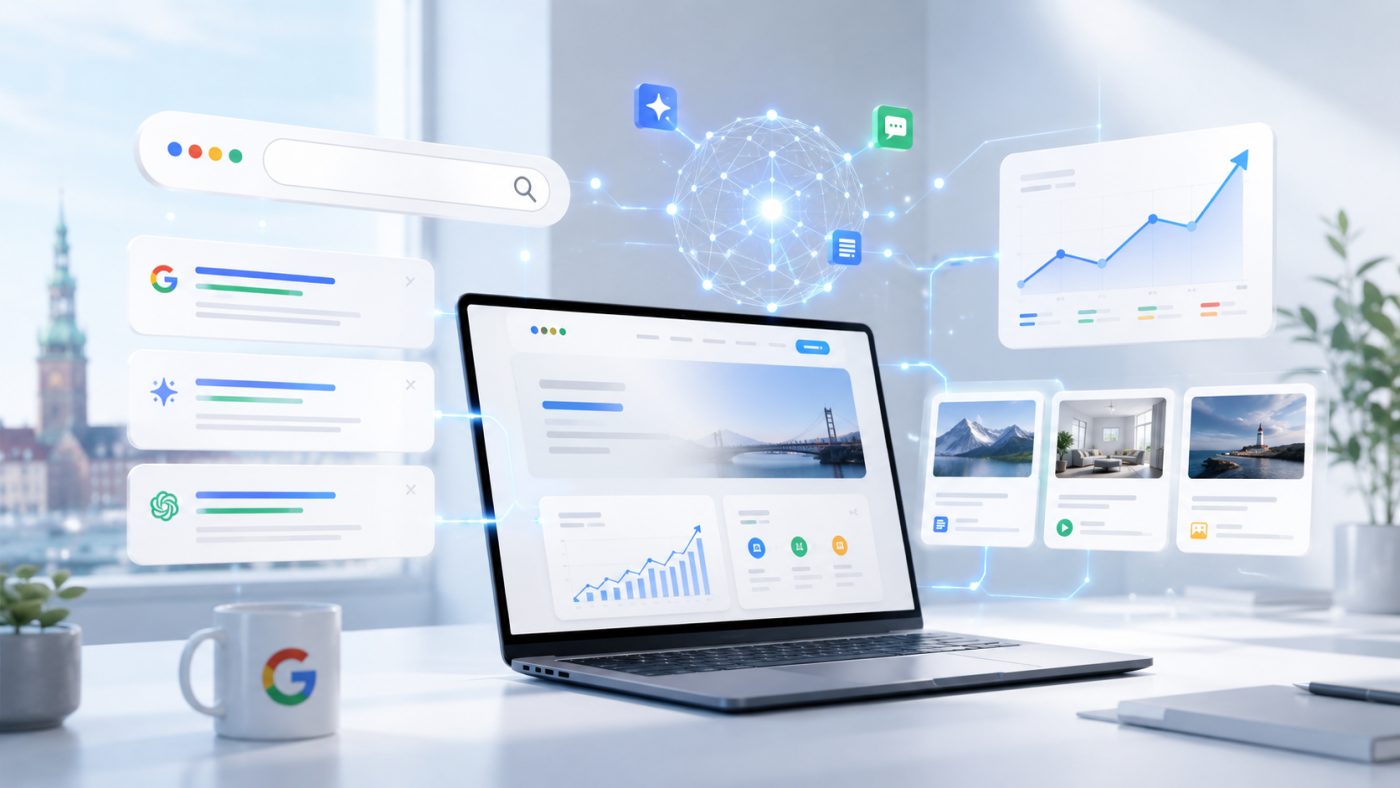
SEO, content, and technical optimisation that make your business easier to find in Google and easier to understand in AI answers.
- Technical SEO and a review of your website
- Keywords, content, and structure that hang together
- Visibility in both Google and AI answers (GEO)
- Honest prioritisation — no empty ranking promises
-
Technical SEO
The foundation: crawling, indexing, structure, speed, and structured data.
-
Keywords & content
Content that matches search intent and supports your real expertise.
-
GEO & AI answers
Clear signals so both Google and AI services understand your business.
-
Measure & prioritise
Focus on effort versus value — not a pretty graph for its own sake.
What I can help with
I help businesses become easier to find, understand, and choose — in both traditional search engines and the new AI services. Not by writing for an algorithm, but by making the business so clear, relevant, and technically accessible that people, Google, and AI systems all have an easier time understanding it.
In practice, I work to make sure your website does not just have text, but clearly explains:
- who the business is
- what it offers
- which problems it solves
- who the solution is relevant for
- which topics you have genuine expertise in
- how pages and topics connect
- why the information is worth trusting
SEO builds the foundation. GEO widens the perspective. The two belong together, and I work with them as one task rather than two separate projects.
Typical solutions
- Technical SEO Crawling, indexing, structure, speed, and structured data.
- Keywords & content strategy Content that matches search intent and your expertise.
- GEO & AI visibility Make your business easier to understand in AI-generated answers.
- Optimising what exists Get more out of the pages you already have.
- Structure & internal links Site structure, internal links, and structured data that connect.
- Measure & prioritise Continuous improvement with a focus on value over numbers.
Follow the work in your own client portal
You should not have to wait for a monthly PDF to know what is happening. As a client you get access to a portal where you can follow the work as it happens and see what I am working on right now.
- Monitored keywords and how your rankings develop
- The tasks I am working on — and what comes next
- Reports and documentation gathered in one place
- Invoices and agreements whenever you need them
It is the same portal I built and use myself every day — so you can always see the status without having to ask.
Dive into the details
The practical and technical side, grouped so you can jump straight to what matters to you.
Visibility is no longer only about ten blue links
When a potential customer looks for a supplier, a product, or the answer to a problem, the journey still often begins with a search. But the way we search is changing.
Some type a couple of words into Google. Others ask a full question. More and more people use AI services for research, comparison, and recommendations. Google increasingly shows answers directly in the results, and services like ChatGPT, Copilot, Gemini, and Perplexity can gather information from several sources and present a finished answer.
That does not remove the need for SEO — quite the opposite. If search engines and AI systems are to understand your business, your website still needs a solid technical foundation, clear content, a logical structure, and clear signals about what you actually know. This is where SEO and GEO meet.
SEO — Search Engine Optimization
The work of improving your visibility in search engines like Google: technology, keywords, search intent, content, internal links, site structure, metadata, structured data, speed, indexing, and authority — plus ongoing analysis of rankings and traffic.
GEO — Generative Engine Optimization
The work of making your business information easier to find, understand, and use in generative search and AI systems. The goal is not necessarily a position as number 1, 2, or 3 — the AI system instead gathers information from several sources into an answer.
Good SEO is not about repeating a keyword 25 times. It is about giving the best and most understandable answer to what the potential customer is looking for — on a website that also works technically.
GEO does not replace SEO
I do not see GEO as a replacement for SEO, and I do not recommend that businesses drop classic SEO to “optimise for ChatGPT” instead. A strong SEO foundation is, in many cases, also a strong foundation for visibility in AI-based services. A website with unclear service pages, thin content, technical indexing problems, and contradictory information does not automatically become strong because you add the word GEO to the strategy.
That is why I work with the two areas together: SEO builds the foundation, GEO widens the perspective. If you want to dig deeper into the difference, I have written more about GEO vs. SEO.
Technical SEO: the foundation has to be in place

We start with the foundation. If Google has trouble crawling, understanding, or indexing your website, even the biggest content effort will not necessarily get to work. Among other things, I review:
- Indexing, robots.txt, and the XML sitemap
- Canonical tags, redirects, and 404 errors
- Parameter URLs and duplicate content
- Hreflang on multilingual websites
- URL structure, internal links, and pagination
- Metadata and structured data
- Mobile rendering, Core Web Vitals, and performance
- JavaScript rendering, where relevant
- HTML structure, headings, and image optimisation
- Crawlability and the technical build of categories and archives
I come from a technical background, so the analysis does not stop at “Google says the page is slow.” I would rather know why. Is it the server? A plugin? Poor database queries? Too much JavaScript? The wrong images? A theme? An external integration?
SEO and web development are closely connected. It is an advantage when the person who finds the problem also understands the technical cause — and in many cases can fix it. If you have a WordPress or WooCommerce solution, I can both find and solve the problem, without the report first having to be translated into technology by someone else. Read more about WordPress development and WooCommerce.
Webshop SEO has its own challenges
SEO for a webshop involves particular issues: product variants, filtering, facets, categories, pagination, discontinued products, product texts, duplicate content, product schema, canonical tags, stock status, and performance. On a larger shop, small technical errors can create thousands of unhelpful URLs — here the technical side is at least as important as the text.
Local SEO, when your customers are nearby
If you have customers in a specific geographic area, local SEO can be relevant: Google Business Profile, consistent business details, local landing pages, reviews, and geographic keywords. But we do not build 74 nearly identical city pages just because we technically can — a local page needs to have real relevance.
Keywords with a focus on the business

A keyword is only interesting if the person searching for it is relevant to your business. So I do not start by finding 5,000 keywords in a spreadsheet. We start with the business: What do you sell? Who buys it? Which problems are the customers trying to solve? When in the buying journey do they search? And do they even use the same words as you?
From there we build a keyword structure around, among other things, commercial searches close to a purchase, problem-oriented searches, informational searches, and brand and comparison searches. They require different content — and it is the intent behind the search, not just the keyword, that decides which page we should build.
Fewer empty articles — more genuine depth
Content is a large part of both SEO and GEO, but more content is not automatically better. 100 shallow AI-generated articles are not necessarily stronger than 20 thorough articles written from real experience. I would rather work with content that has a function: stronger service pages, industry landing pages, FAQs, guides, comparisons, concrete problem solutions, cases, and concept explanations. Every page should have a purpose — to attract a relevant search, support an important topic, move the user further, or strengthen your documented expertise. Preferably several of these at once.
I also optimise what you already have
You do not always have to write something new. On many websites there are good pages that rank on page 2, get many impressions but few clicks, compete with another page, lack subtopics, have a weak title, or hit a slightly wrong search intent. Here a targeted update can be far more valuable than yet another blog post. So I look at both what we are missing and what we already have that could be better.
Competitor analysis: what already works?
We do not have to guess. If others already rank well for the searches we want, it is worth understanding why: which pages rank, how thoroughly the topic is covered, which subtopics Google associates with the search, and how the results page looks. The goal is not to copy, but to understand the level before we make something better, more specific, or more useful.
Visibility without ruining the text
A text should first and foremost work for the person reading it. A relevant keyword may well appear in a heading, and an important topic may be mentioned more than once. But if the text becomes worse for the human in order to satisfy an idea about an algorithm, we have chosen the wrong strategy. Good SEO makes the content better and clearer — not more artificial.
Make the business easier for AI to understand

GEO is not about one trick, but about many small signals that together make your information clearer to machines. It can involve, among other things:
- Clear descriptions of who you are, where you are, which services you offer, and who you typically help.
- Clear entities and relationships — people, business, products, services, cases, and areas of expertise that connect logically.
- Concrete expertise — “we deliver innovative, high-quality solutions” says very little; a specific section on how you solve a particular problem is worth far more.
- Questions and clear answers — FAQs that answer real questions rather than filling the page with keywords.
- Cases and documentation — what was solved, how, with which technology, and with what result.
- Structured data — schema.org for business, person, article, product, service, or FAQ, implemented correctly.
Structured data is not a place to write information that is not visible on the page, purely in the hope of an advantage. It should reflect what actually appears on the website.
Can you get my business mentioned in ChatGPT?
The short answer: I can work deliberately to make your business far easier to find, understand, and assess. But I cannot promise that ChatGPT, Gemini, or another AI service will show your business in a specific answer — no serious consultant can guarantee that.
The result depends on, among other things, the user’s question, the service, the model, the available sources, timeliness, geography, your online presence, and the competitors. That is why I would rather work with a robust foundation than sell a shortcut.
SEO is not a one-off task — but it need not be a subscription forever either
Some businesses need ongoing SEO. Others have a more defined problem. So an engagement can look different:
SEO/GEO analysis
A thorough review of the website, technology, content, competitors, and opportunities. You get a prioritised plan rather than just a list of errors.
A defined optimisation project
We solve a bounded task: technical errors, a new information architecture, service pages, keyword analysis, a content plan, a GEO review, or webshop structure.
Ongoing SEO & GEO
For those who want to work systematically over time. We follow the development, prioritise the next effort, and work continuously with technology, content, and opportunities.
You should not have to buy a set number of articles each month because a package says “4 articles.” We work with what makes the most sense.
What do you get out of the collaboration?
Depending on the task, the deliverable can include a technical SEO audit, a prioritised action plan, keyword analysis, keyword mapping, competitor analysis, a content gap analysis, suggestions for new landing pages, optimisation of existing pages, content briefs, new copy, an internal linking strategy, structured data, metadata, technical changes, backlink analysis, GEO analysis, and ongoing reporting. I document what is done, why — and what the next step should be.
I can both advise and implement
An SEO report is not worth much if it ends up as PDF number 47 in a folder. When the analysis finds an incorrect canonical, poor redirects, slow templates, unhelpful parameters, missing structured data, or wrongly implemented hreflang, I can in many cases also fix it. If you already have a development team or agency, I am happy to work with them.
Link building without random links
Links are still part of SEO, but a link is not valuable simply because it is a link. I prefer relevant industry media, partners, suppliers, organisations, professional articles, and existing mentions without a link — over 500 random links from sites no human ever visits. Quality and relevance matter more than an impressive number in a report.
What do I not promise?
I do not promise “number 1 on Google in 30 days,” and I do not promise that your business will be recommended by ChatGPT. SEO does not work that way. What I can promise is a transparent process where decisions are explained, the work is documented, and the effort is prioritised by what can realistically move the needle. If I judge that a keyword is not worth the money — or that the problem is the website rather than SEO — I say so.
Already have an SEO agency?
That is not necessarily a problem. I can give a second opinion: what is actually being done, do the chosen keywords make sense, are the technical recommendations correct, and does the work also support GEO? Sometimes the conclusion is that the existing work looks sound — that is a useful answer too.
How it works
- 01 We work out where you stand I review the website, your key services, the target audience, and the visibility you already have. If you have data from Search Console or Analytics, we bring it in.
- 02 We find the opportunities We look into searches, competitors, existing content, technical problems, and the topics you have yet to cover.
- 03 We prioritise Not all errors are equally important. You get a prioritised plan focused on effort versus expected value.
- 04 We implement I carry out a large part of both the technical work and the content work myself — or collaborate with your suppliers.
- 05 We measure and adjust Rankings and traffic are interesting, but the goal is relevant visitors, enquiries, and business — not a pretty graph.
Frequently asked questions
What is GEO?
GEO stands for Generative Engine Optimization and is about making a business’s information easier to understand and use in generative search and AI systems. I see GEO as a supplement to SEO — not a replacement.
Can you guarantee a specific position on Google?
No. No serious SEO consultant can control Google’s results or guarantee a specific position. We can analyse, optimise, measure, and improve the likelihood of stronger visibility.
Can you get my business shown in ChatGPT?
I can optimise your digital presence so your business, expertise, and information become clearer and more accessible. I cannot decide which businesses a given AI model chooses to mention in a specific answer.
How quickly does SEO work?
It depends a lot on the starting point. A technical error can sometimes be fixed quickly, while new content and competitive keywords can take longer. I prefer to set expectations based on your specific website rather than a general promise of three or six months.
Do I have to write lots of blog posts?
Not necessarily. On some websites the most important opportunities are entirely different: better service pages, technical fixes, better categories, internal linking, updating existing pages, or cases. Content should have a function.
Do you only work with WordPress?
No. I work with WordPress, WooCommerce, and custom-built solutions, among others. The technical approach depends on the platform.
Can you implement the changes?
Yes. I can advise, write content, and implement many of the technical changes. If a task requires a specialist in an area I should not handle myself, I say so and am happy to collaborate with others.
Can you give a second opinion on my current SEO work?
Yes. I can review the effort and give a technical and commercial assessment — even if you keep your current agency. Sometimes the conclusion is that the work looks sound, and that is a useful answer too.
Ready to take the next step?
Tell me what you are dealing with and what you want to achieve — you get an honest take on scope, options, and the next step.
- 12+ years of experience
- Personal sparring
- No long lock-ins
- Focus on results
- Peace of mind & support