
Service
Talks on AI
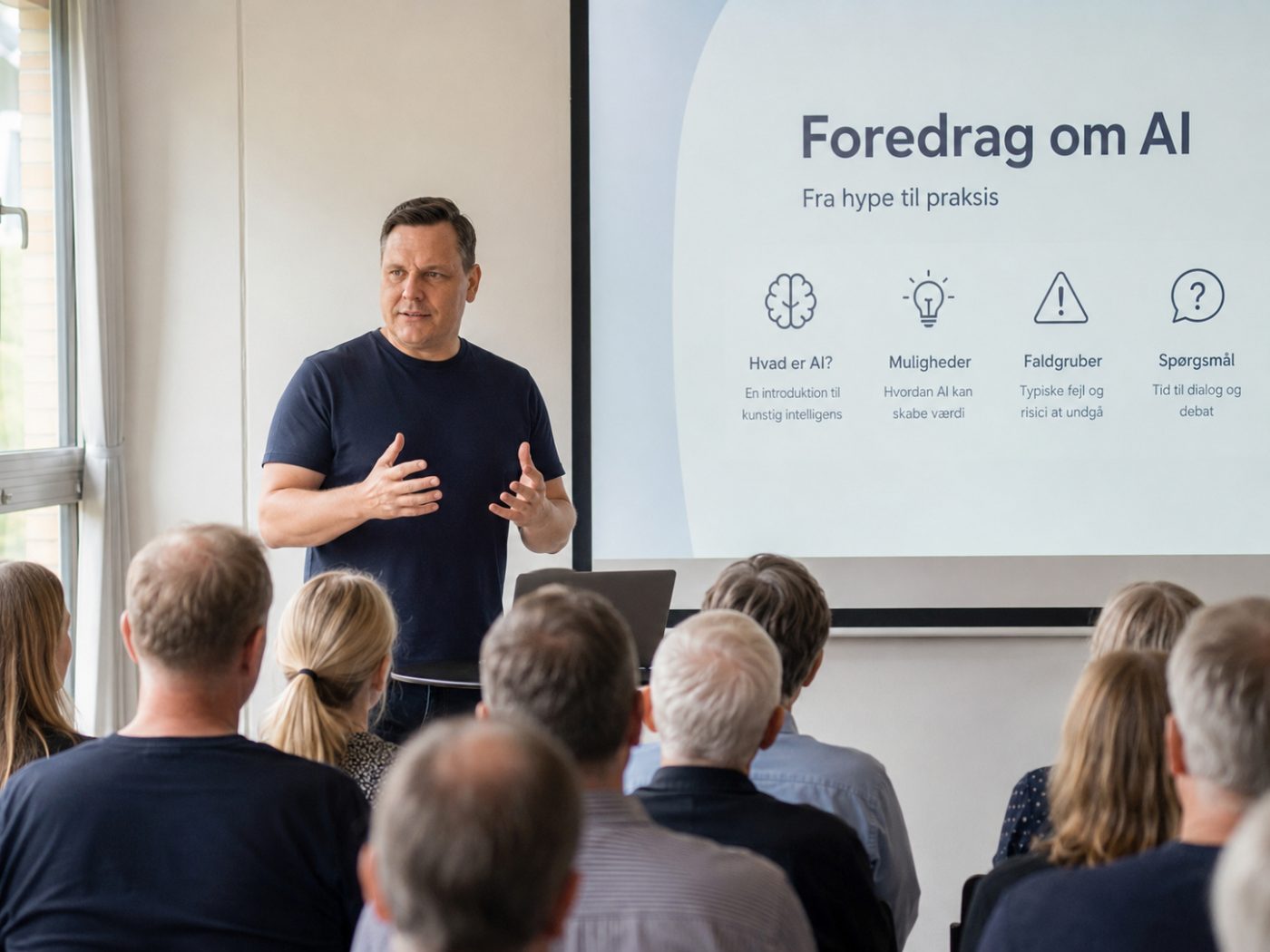
A down-to-earth, engaging talk on artificial intelligence — tailored to your audience, level, and occasion. From hype to practice.
- Down-to-earth and engaging — from hype to practice
- Tailored to your audience, level, and occasion
- Live demos of current AI tools
- From ChatGPT to AI agents and automation
-
Tailored to you
Not a canned slide deck — the content is shaped around your audience and purpose.
-
Down-to-earth
AI made understandable with real-world examples, not technical jargon.
-
Live demos
I would rather show than tell — AI tools in action in front of the room.
-
Without the hype
Both the excitement about the possibilities and an understanding of the limits.
A down-to-earth talk on AI
In record time, AI has become part of our working day, our information searches, our communication, and the digital tools around us. But what does it actually mean in practice? What can AI already be used for, what is mostly hype, and how do we use the technology without checking our critical thinking at the door?
Those are some of the questions I take on when I give talks on AI. My goal is not to impress with technical terms or predict exactly what the world will look like in ten years. I would rather make artificial intelligence understandable, concrete, and relevant — grounded in the tasks, decisions, and challenges that businesses, organisations, and people already face. You should not have to fit into a finished presentation. The presentation should fit you.
A talk on AI can, among other things, be about:
- how AI can be used concretely in the working day
- ChatGPT, Claude, Gemini, and other AI tools
- prompting — and why context matters more than a “magic prompt”
- AI agents and the next generation of AI tools
- automation of manual work processes
- AI and the future workplace
- hallucinations, source criticism, and responsible use
- deepfakes, misinformation, and digital judgement
- data security and confidential information
But the list is not a fixed agenda. Together we find the angle that makes the most sense for your event.
Dive into the details
The practical and technical side, grouped so you can jump straight to what matters to you.
A talk on AI should be about more than ChatGPT
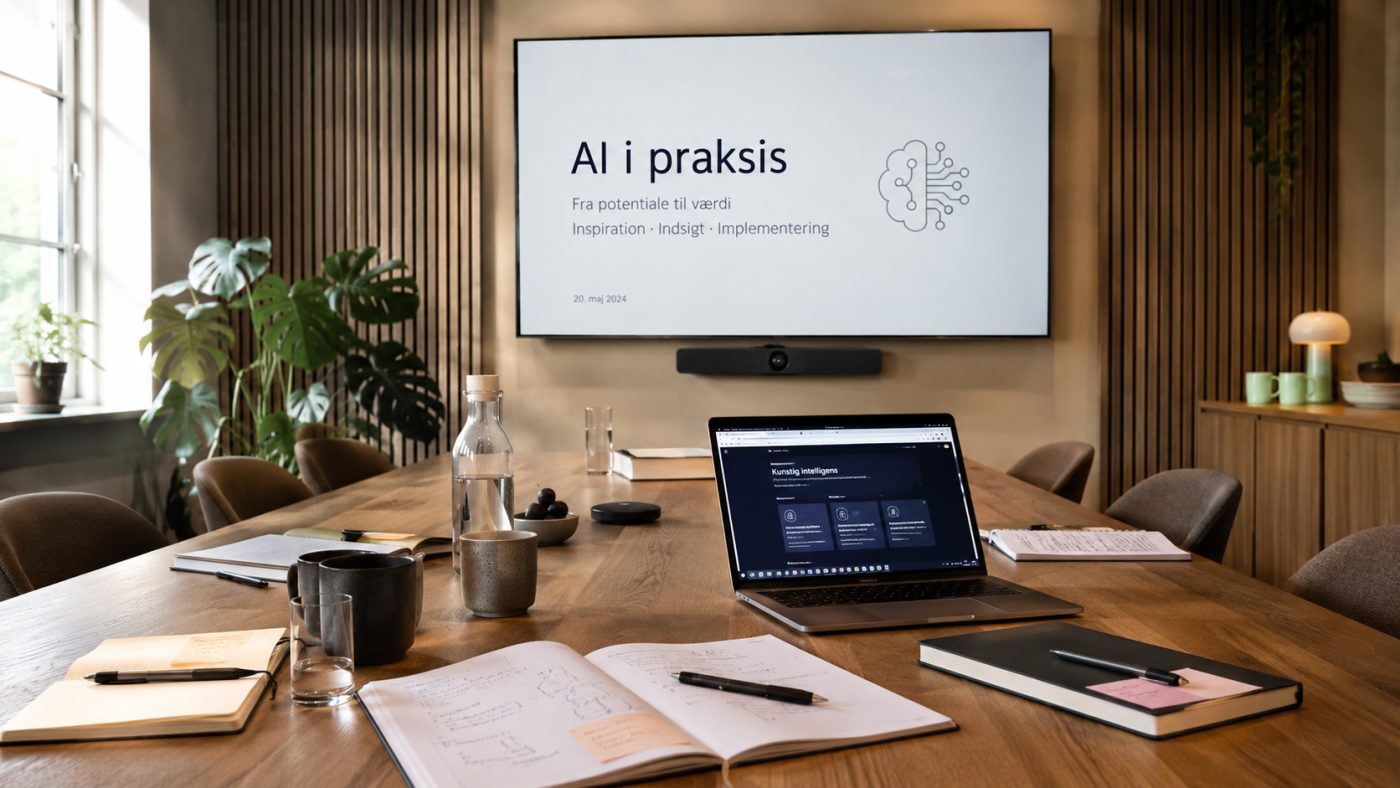
For many, ChatGPT was the first real encounter with modern artificial intelligence. Suddenly you could hold a conversation with a computer, have it write text, analyse material, and come up with ideas in seconds. That was — and still is — impressive. But ChatGPT is only a small part of what is interesting about the development we are in the middle of.
AI can work with text, images, audio, video, documents, data, and software. It can be used as a sparring partner, analyst, research assistant, and creative collaborator. And the development keeps moving: from systems that mainly answer to systems that can increasingly act.
AI in the working day
Where can artificial intelligence actually make a difference between nine and five? That is perhaps the most relevant question for most businesses. We can talk about big technological revolutions, but AI only gets really interesting when you can relate it to everyday tasks: creating an overview of large amounts of information, analysing documents, preparing meetings, drafting first versions, rewriting communication, brainstorming, doing research, working with data, or helping with technical tasks.
The point is not that AI should take over the work. The point is to understand where the collaboration between people and technology makes sense. For some tasks AI is fantastic. For others it is mediocre. And for some it should not be used at all. That difference is the interesting part.
ChatGPT and the new AI tools
“How do you actually use ChatGPT properly?” is still a relevant question — but the answer is rarely just a list of 25 clever prompts. A good result depends on the context the AI gets, how the task is described, the material it works with, and how we assess the result afterwards. Depending on the audience, the talk can touch on tools like ChatGPT, Claude, Gemini, and other platforms — not to crown a winner, but to show what the category can do and how to think about it. The tools will change. The ability to understand the possibilities is more durable.
From prompts to AI that knows the context
The first years of generative AI became very much about prompts. Prompts are important, but AI becomes far more interesting when we give it the right context. If it is to answer a customer enquiry, it is relevant to know the company’s products, tone, and guidelines. If it is to analyse a document, it needs the document. It sounds obvious, but it moves AI from being a very intelligent guessing game to becoming a real tool. That is often an important point for organisations that have already tried ChatGPT but find the results vary a lot.
AI agents — when AI starts performing tasks
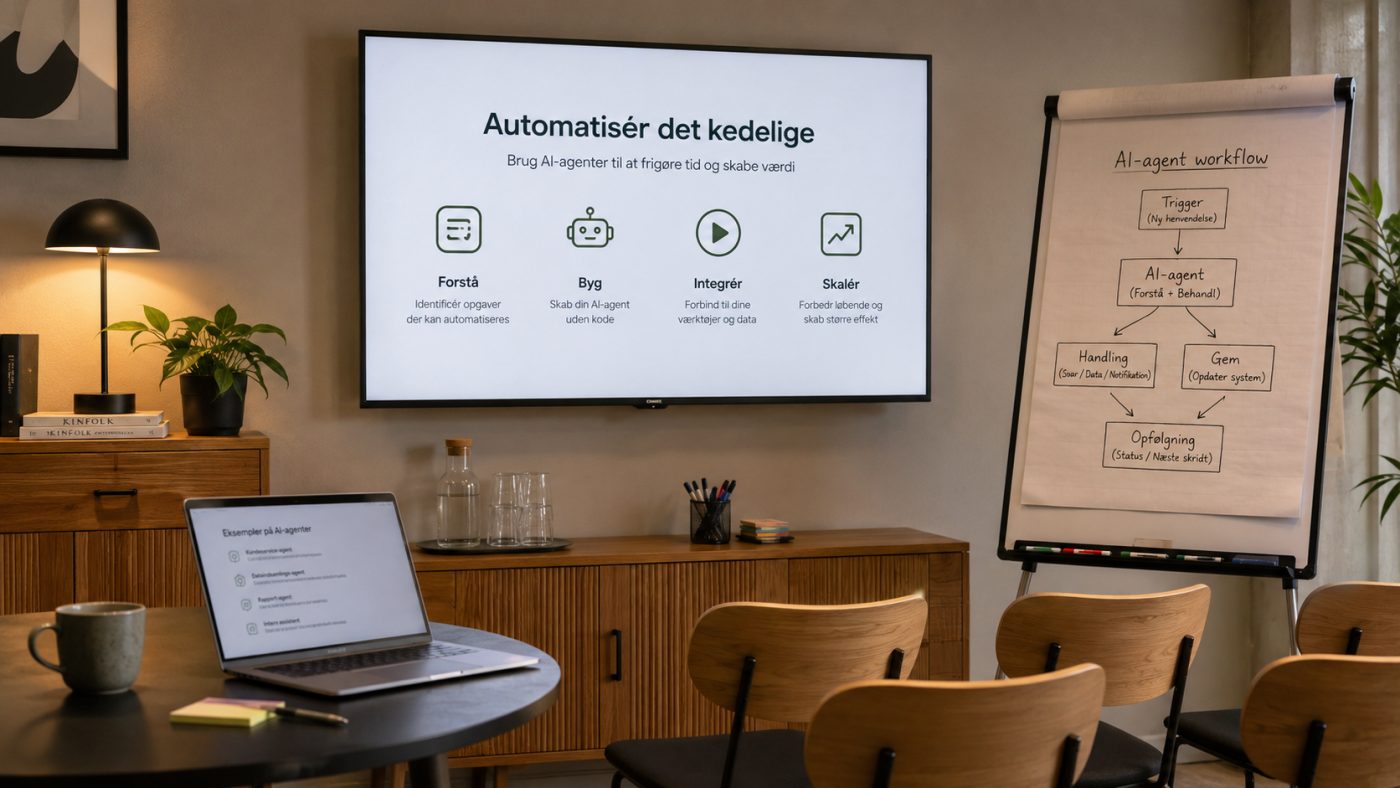
What happens when AI no longer just produces an answer, but can work through several steps of a task? Picture the difference:
AI that answers
“Write a draft reply to this customer enquiry.”
AI that acts
“Read the enquiry, find the relevant order, check the delivery status, compare it against our guidelines, draft a reply — and pass the case to a human if anything is unusual.”
The latter is suddenly not just about generating text. It is about workflows. This is where AI moves closer to automation, software, and the company’s other systems. AI agents are therefore an obvious topic for businesses that want to understand what comes after the ordinary chatbot. We can look at what an AI agent actually is, the difference between a chatbot, an automation, and an agent, when a human still needs to be involved, and what new risks arise when AI is allowed to act. It is not science fiction — but it is not magic either. And that distinction matters.
Can we get rid of some of the boring work?
A surprisingly large part of the working day still consists of tasks that follow almost exactly the same pattern every time: an email comes in, information is copied, a system is opened, a task is created, a colleague is notified, a document is saved, a confirmation is sent. It works — but it is not necessarily a good use of people’s time.
Here it is important to distinguish between traditional automation and AI. If a process follows fixed rules, ordinary automation is often cheaper, more stable, and more predictable. AI becomes interesting when the task contains something that used to be hard to automate: text, interpretation, categorisation, summarisation, or decision support. The combination can be powerful — and it is an area I find especially interesting, because it sits at the intersection of AI, systems, integrations and real work processes. A talk with this angle is less about “look what ChatGPT can write” and more about: why do we still do this task manually?
Vibe coding — when building software gets easier
AI is also changing the way software is created. Increasingly, you can describe a problem or a desired tool in plain language and use AI as an active part of building the solution. This is often called vibe coding. It does not mean that technical understanding has become unnecessary — but the threshold for creating small internal tools, prototypes, and specialised solutions is getting lower. The idea “it would be smart if we had a little system that could …” need not necessarily end in a six-month IT project. It is a relevant angle if the audience is interested in where AI is heading after ChatGPT.
When AI becomes a colleague — what happens to our work?
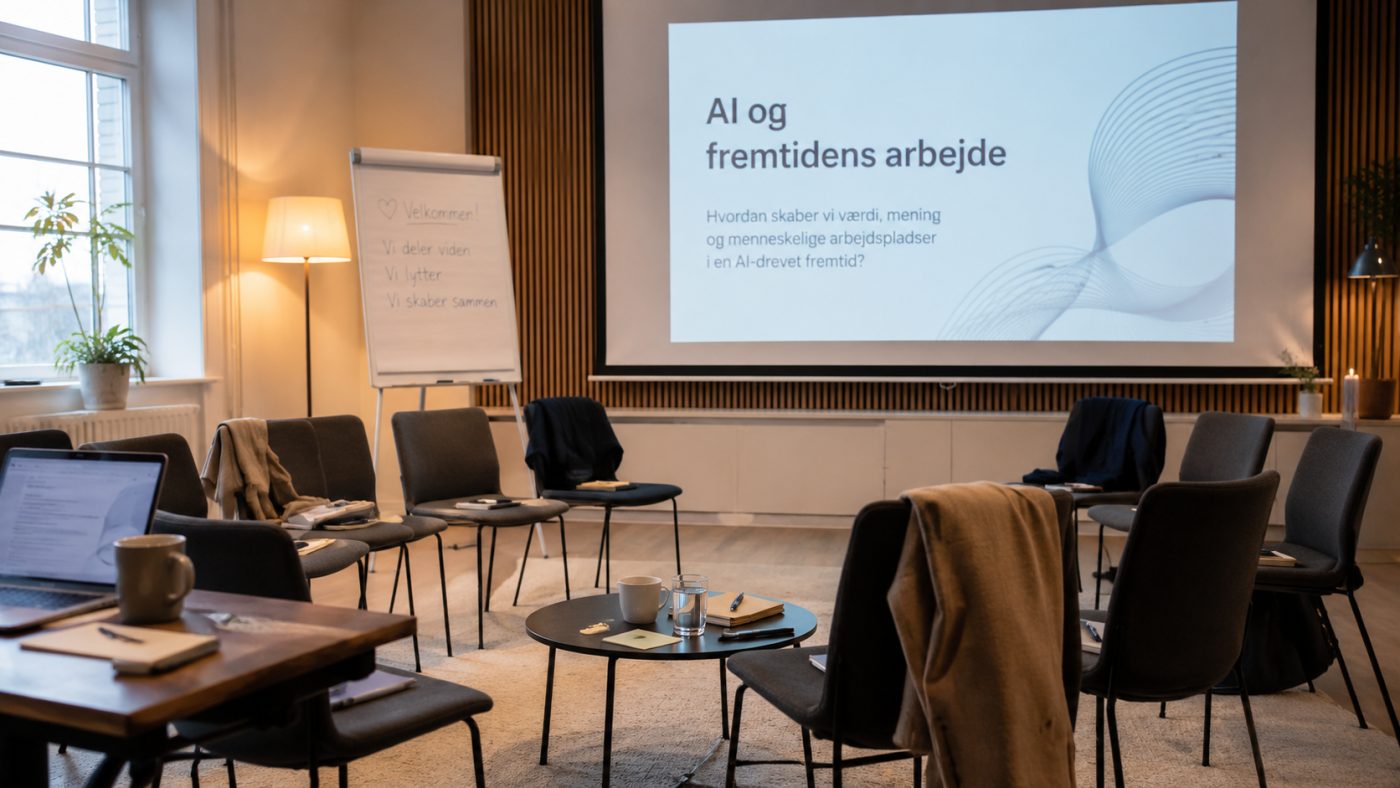
“Will AI take our jobs?” almost always comes up, and that is understandable. Generative AI can already handle parts of tasks that until recently required a human. But “will AI replace my job?” may not always be the most useful question. A better one can be: which parts of my work will change?
A job rarely consists of a single task. It consists of many — some routine, some requiring experience, relationships, professional judgement, creativity, or responsibility. Some should perhaps have been automated ten years ago. So a talk on AI in the workplace can also be about how our roles change when AI becomes a natural part of the toolbox: Which skills become more important? How do we avoid losing expertise? How do we check a result if we can no longer do the task ourselves? And when does greater efficiency turn into worse quality?
There is no single answer. But these are questions more and more workplaces have to grapple with — and they are often more interesting than yet another demonstration of what the technology can do.
Can you trust AI?
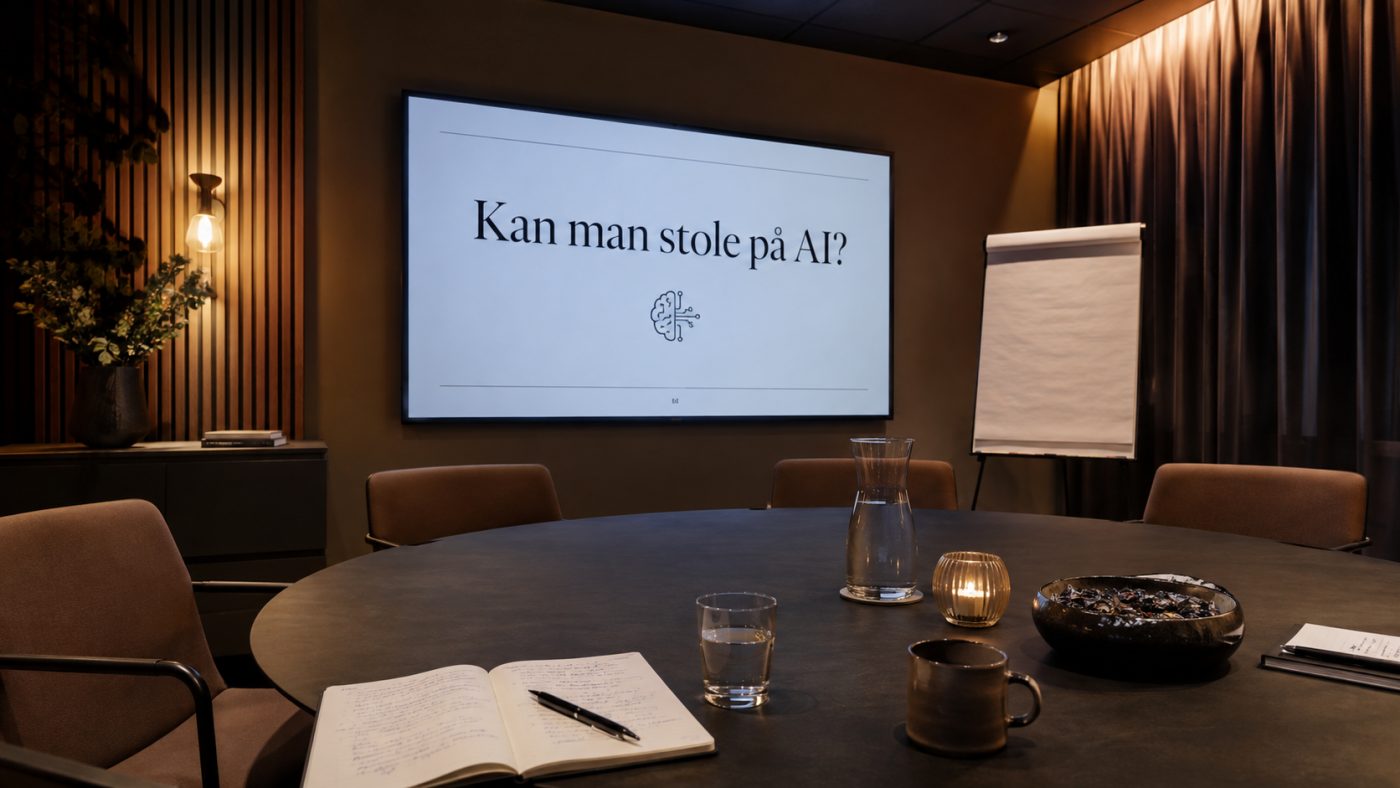
An AI system can deliver an answer in seconds, write it professionally, structure the argument, and sound confident — and still be wrong. That is one of the most important things to understand about generative artificial intelligence. So a talk can focus on hallucinations, source criticism, and human control: How do we assess an answer? When should information be verified? And what happens when people start trusting a system because it sounds competent? AI can be a fantastic tool. But it is a poor place to park your responsibility.
Deepfakes and a reality that is harder to verify
Generative AI is no longer only about text. We can create images of people who never existed, alter photographs, generate voices, and create video — and the quality keeps improving. That opens enormous creative possibilities, but at the same time makes source criticism and digital judgement more important. A talk can therefore also take a more society-oriented angle and address AI-generated images, synthetic audio, deepfakes, misinformation, fraud, and trust in digital material. It is an area that can both fascinate and worry — and one we all need to learn to navigate.
Data, confidentiality, and responsibility
Just because you can paste something into an AI tool does not mean you should. When AI becomes part of the working day, very practical questions arise: What information may employees share? Which tools does the company use? What do we do with customer data and internal documents? When should an employee stop and ask someone responsible? It is not the flashiest part of AI, but it is important. I try to handle these questions without turning the talk into a ninety-minute compliance course. The goal is understanding — that participants leave with both the desire to use the possibilities and a healthy sense of when to be careful.
AI without the hype
I genuinely think AI is one of the most exciting things to happen in technology in many years. But that does not mean AI is the answer to everything. Sometimes the solution is AI. Sometimes an ordinary automation. Sometimes an integration between two systems. And sometimes you should leave things as they are. AI actually gets more interesting when we stop treating it as magic — because then we can start asking the questions that matter: What problem are we trying to solve? Can AI help? How? What is the risk? And is it even the best solution?
The talk starts with you
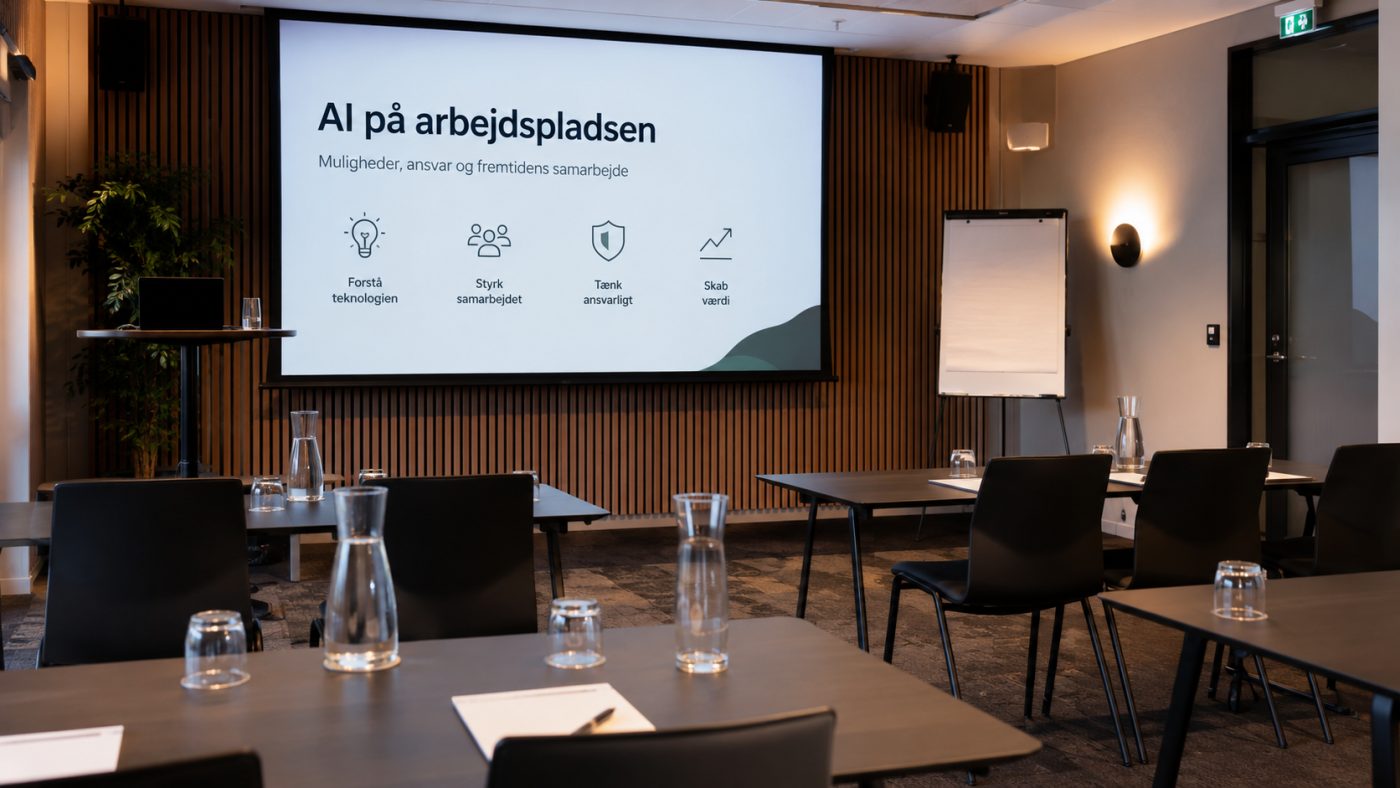
A talk for a management team should not necessarily have the same focus as a talk for 150 employees. A business network has different questions than an association, and an organisation where almost no one uses AI yet needs something different than one where employees already use ChatGPT every day. So before the talk we have a short conversation about the event, the participants, and what you want to get out of it. That way the talk does not become just “something about AI” — it gets a direction.
You do not need to know exactly what you want to hear about. An enquiry can be as loose as: “We are holding a theme day for about 80 employees. The level varies a lot, and we would like something about AI that both inspires and makes us a bit wiser about what we can actually use it for.” That is plenty to start with. Then together we find an angle that fits the participants and the rest of the event.
Who is a talk on AI relevant for?
I give the talk in language where you do not need to be a programmer to follow along, and it can be adapted to very different audiences:
Businesses
A shared starting point for talking about AI — for staff days, inspiration days, strategy days, kick-offs, management meetings, or internal conferences. The focus can be application, workflows, and the future workplace.
Business networks
A broader view of the possibilities: How do businesses use AI? What is realistic right now, and where is the development heading? Cases can be adapted to the industries in the room.
Public organisations
A professional inspiration talk for municipalities and institutions — about employees’ working day, responsible use, new ways of working, and source criticism.
Associations & conferences
A broader, more society-oriented talk — or a compact keynote format where AI is one element in a larger programme with a strong through-line.
What should participants take home?
A good talk should do more than make people think “wow, technology is wild.” It may fascinate, but there should also be something left the day after: a better understanding of what modern AI can and cannot do, concrete ideas for tasks and areas where the technology could be relevant, a more nuanced view (AI is neither fairy dust nor the end of the world), a healthy critical sense — and a good starting point for the internal conversation about how you want to use AI.
I would rather show than tell
AI is an obvious topic to demonstrate live. Instead of only showing slides, relevant parts of the talk can include small, concrete demonstrations of current AI tools: How does the result change when the AI gets better context? How can it work with a document? And what happens when the AI gets it wrong? Live examples make the technology less abstract — it is easier to form an opinion about something you have just seen happen in front of you.
My starting point is practice
I work as a freelance digital consultant at the intersection of technology, business, and people — day to day with AI, automation, integrations, web, and software, among other things. That shapes the way I talk about AI: I do not just look at the technology from the outside, but care about how it actually connects to a task, a process, or a system. Because there is a big difference between an impressive demo and a solution that still makes sense after three months. You can read more about me.
Format, length, and location
A talk on AI is typically 45–90 minutes, depending on the event and the desired depth: a concentrated inspiration talk of 45 minutes, a classic talk with room for perspective, cases, and demonstrations at 60 minutes, or a more in-depth talk of 75–90 minutes with more time for questions and dialogue. If you have a different frame, we will work it out. I am based on Funen and am happy to give talks in Odense and the rest of Funen — but of course also travel to events elsewhere in Denmark. What matters is not the postcode, but finding the right format for the participants.
What does a talk on AI cost?
The price depends on the format, length, location, and degree of tailoring. Send me a few details about the event — date, location, approximate number of participants, and a bit about the purpose — and I can give you a specific price.
Frequently asked questions
What is a talk on AI about?
It depends on the audience and the event. A talk can be about practical use of generative AI, ChatGPT, AI in the workplace, AI agents, automation, the future job market, deepfakes, data security, or AI's possibilities and limits. The content is adapted so the most relevant topics get room.
Can the talk be tailored to our industry?
Yes. It is a central part of my approach. Before the talk we discuss your participants, industry, level, and purpose, and where it makes sense I adapt examples and angles to your reality.
Do participants need to know about AI in advance?
No. The talk can be held for participants without special technical background. If the audience already works actively with AI, the level can be raised so we spend less time on introduction and more on things like AI agents, automation, and more advanced use.
Is it a technical AI talk?
Only to the extent that it makes sense. I have a technical background and can go into the technology when relevant, but the goal is not to impress with jargon. The goal is for participants to understand what the technology means and can be used for.
Do you also talk about ChatGPT?
Yes. ChatGPT is a natural example in many talks, but the talk is not necessarily only about ChatGPT. Depending on the angle, we can also touch on other AI assistants, generative AI in general, AI agents, automation, and the broader development.
Can the talk be about AI agents?
Yes. AI agents are especially relevant for organisations that want to understand the next step after ordinary AI chatbots. We can look at how AI increasingly can work through several steps of a task, use tools, and take part in automated work processes.
Do you also talk about the risks of AI?
Yes. A serious talk on AI should, in my view, not only be about possibilities. Depending on the audience, we can talk about hallucinations, misinformation, deepfakes, confidential information, data security, responsibility, and the need for human control.
How long does the talk last?
Typically between 45 and 90 minutes. The length is adapted to the event — feel free to contact me if you have a specific slot in the programme.
Can the talk be part of a conference or theme day?
Yes. It can both stand alone and be part of a larger event, for example a conference, staff day, inspiration day, professional day, or a networking event.
Do you give talks on AI on Funen and in Odense?
Yes. I am based on Funen and am happy to travel to events in Odense and the rest of Funen. I also give talks elsewhere in Denmark.
What does a talk on AI cost?
The price depends on the format, length, location, and degree of tailoring. Send me a few details about the event, and I can give you a specific price.
How do we book an AI talk?
Send me a message with a bit of information about the event. It does not have to be a finished brief — date, location, audience, number of participants, and a short description of what you have in mind is a great starting point. Then we have a conversation about the content and find the angle that makes the most sense.
Ready to take the next step?
Tell me what you are dealing with and what you want to achieve — you get an honest take on scope, options, and the next step.
- 12+ years of experience
- Personal sparring
- No long lock-ins
- Focus on results
- Peace of mind & support