Nordic SaaS & content platform
NorDok
A data-driven Nordic platform for marinas — Laravel API, Nuxt frontend, automated data collection, and more than 5,300 harbours in five languages.
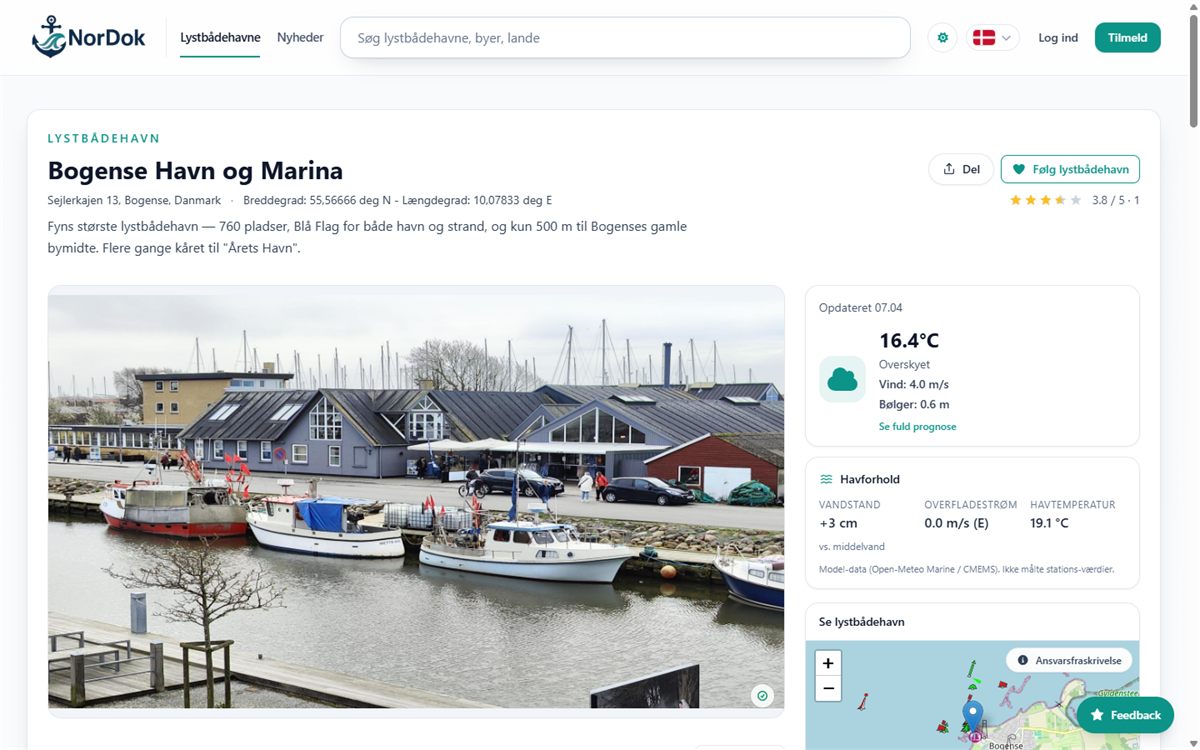
NorDok is a multilingual platform that gathers information about marinas, harbours, and slipways across Northern Europe.
The project grew out of a simple problem: it can be surprisingly hard for sailors to find up-to-date, comparable information about harbours. Water depth, facilities, prices, contact details, and access conditions are often scattered across the harbours’ own websites, PDF files, municipal pages, and various national harbour listings.
The goal of NorDok is to gather this information into one modern, user-friendly solution where sailors can easily find relevant harbours — and where the harbours can take over and manage their own profile. NorDok is built as an independent SaaS and content platform with Laravel as the API backend and Nuxt as the frontend.
My role in the project
NorDok is my own project, where I have been responsible for the whole process — from idea and business model to architecture, development, and operations:
- Idea and concept development
- Business model and product strategy
- Data model and system architecture
- Backend and API development
- Frontend and user experience
- Automated data collection
- Multilingual content and international SEO
- Administration and moderation
- Hosting, deployment, and ongoing operations
- Communication with harbours and potential partners
The project therefore combines product development, software architecture, automation, data processing, SEO, and commercial platform thinking.
Technical solution
NorDok is built as an API-first application. The backend is developed in Laravel, while the interface is built separately in Nuxt. This separation makes it possible to develop frontend and backend independently and provides a solid foundation for later mobile apps, integrations, and external API access.
The stack includes Laravel 12, Nuxt 4, MySQL, Redis, Laravel Horizon, Tailwind CSS, Pinia, Nuxt i18n, and Leaflet, OpenStreetMap, and OpenSeaMap for map data. Laravel handles users, harbour data, permissions, images, reviews, administration, subscriptions, and automated processes through queued background jobs. Nuxt drives the public interface, search, map view, harbour profiles, user areas, and the SEO-optimised landing pages.
Automated collection and structuring of harbour data
A significant part of NorDok is the automated collection of information about marinas. Harbour information is rarely in a uniform format — the same fact can be stated differently from country to country and site to site. So it is not enough to simply fetch data. The information must also be normalised, validated, and linked to the correct harbour.
NorDok is built to process and structure data such as harbour name, address and coordinates, country and region, contact details, water depth, maximum boat length and beam, number of berths, facilities, fuel, showers and toilets, power and water, Wi-Fi, slipways, winter storage, boatyard, restaurants and shopping, prices and payment information, plus images and other media.
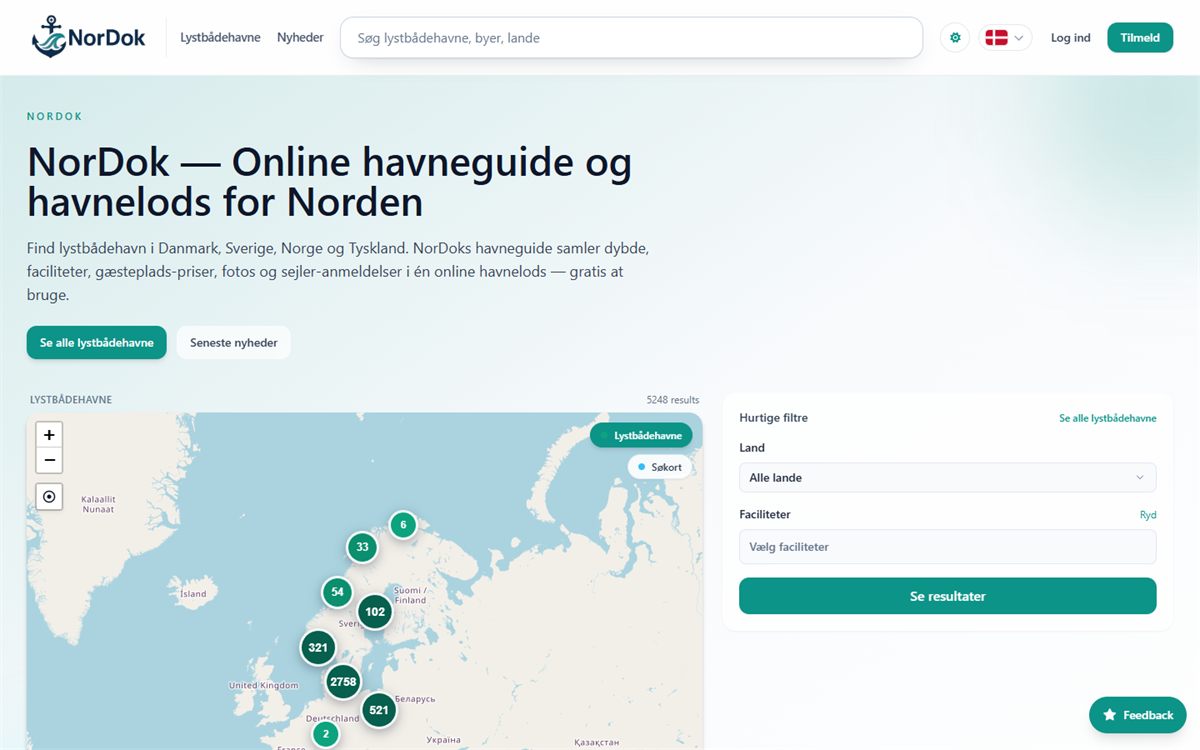
The automated processes reduce the need for manual registration and make it possible to build a large database across several countries. The database already holds more than 5,300 marinas and harbours across Denmark, Sweden, Norway, Germany, and Poland. Data collection is not a one-off import — the architecture is built so information can be continuously enriched, updated, and quality-assured.
Search and interactive map
The core user experience is built around search and an interactive map. Users can explore harbours geographically or search for specific facilities and attributes — for example a harbour with a slipway, fuel, showers, a restaurant, or a certain minimum depth.
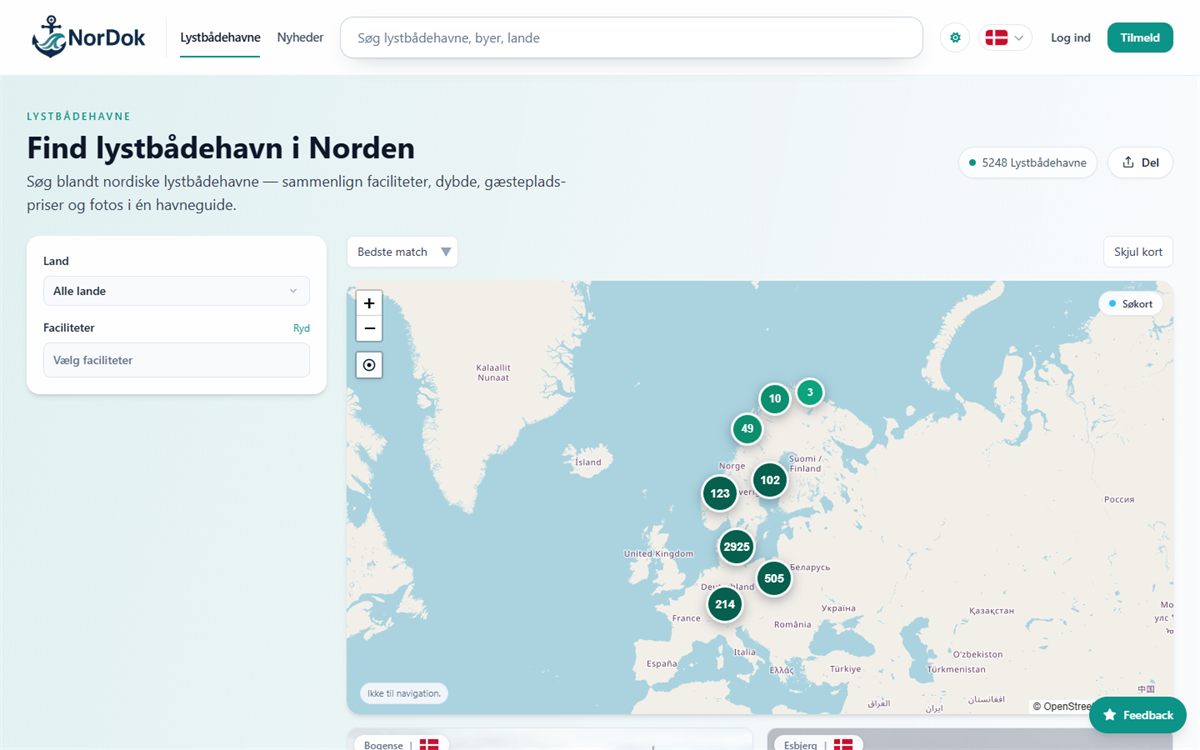
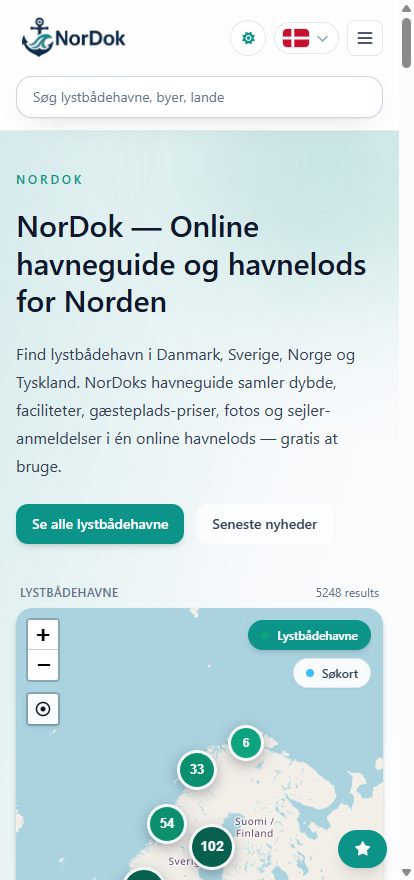
The map is based on Leaflet and OpenStreetMap with the option of nautical map data from OpenSeaMap. Each harbour appears as a point on the map linked directly to a detailed profile. The solution is designed for both desktop and mobile, since many sailors use the platform on the move from a phone or tablet. It supports map-based exploration, geographic search, filtering by facilities and technical data, nearby harbours, featured Premium harbours, and direct navigation to profiles.
Comprehensive harbour profiles
Every marina has its own profile page with structured information. The profiles are built so a sailor can get an overview quickly, while also finding the more technical detail needed when planning a trip.
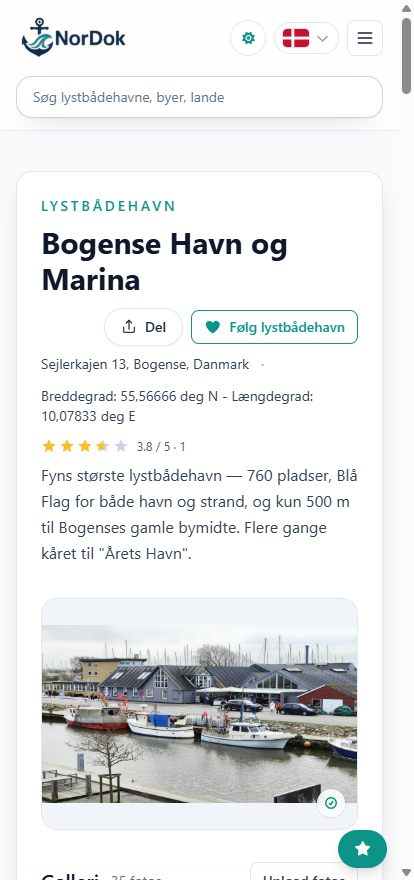
A profile can include a description, location on the map, contact details, technical dimensions and limitations, facilities, prices, images, news, events, reviews, practical information, and related harbours nearby. The information is stored as structured data rather than one long text, which makes it searchable, comparable, and usable across the platform.
User profiles and a personal harbour overview
Private users can create their own profile on NorDok. From it they can save and follow harbours of interest — a personal overview for upcoming trips, holiday planning, or keeping an eye on news and events from particular harbours.
The user system is built as a foundation for several community features: saving favourite harbours, following harbours, seeing previously visited profiles, writing reviews, contributing images, and managing their own details. In the longer term, user profiles enable more personalised recommendations, route planning, guest-berth features, and communication between sailors and harbours.
Harbours can take over and manage their own profile
A central part of the business model is that the marinas can take over management of their own profile. When a harbour is created through automated data collection, the profile first exists as a public information page. The harbour’s administrator can then request ownership.
NorDok supports a claim flow where the link can be validated against the harbour’s domain and the administrator’s email address. After approval, the harbour gains access to an admin area where it can update contact details, edit the description, change facilities and prices, enter technical data, upload images, publish news, create events, and follow activity around the profile. NorDok is therefore not just a static harbour catalogue — it lets harbours maintain and develop their own digital presence.
Multilingual platform
NorDok is built as a genuinely international platform, not a Danish site translated afterwards. It supports Danish, Swedish, Norwegian, German, and English — covering the interface, the editorial content, and the individual harbour profiles.
Text and labels are not hardcoded in the frontend. The architecture uses locale-based content, so text, metadata, and SEO elements can be managed per language — navigation, facility types, landing pages, harbour descriptions, articles, news, events, forms, emails, error messages, SEO titles, meta descriptions, Open Graph data, and structured data. Each language version can be indexed separately with hreflang, local URL structures, and dynamic sitemaps. That lets a German user find a Danish marina through a German-language search — and a Danish sailor find a Swedish, Norwegian, German, or Polish harbour in their own language.
SEO and programmatic content
NorDok is built with a strong focus on organic visibility. The many harbour profiles form a natural basis for programmatic SEO, where each harbour, region, facility, and country combination can anchor a relevant landing page — for example "marinas in Denmark", "harbours with a slipway", "marinas with a restaurant", or "harbours with room for larger boats".
Editorial content about sailing, safety, equipment, harbour life, and maritime news is produced alongside it. The articles support both the users and the platform’s organic visibility and can be linked directly to relevant harbours, areas, or facilities.
Premium profiles for marinas
NorDok includes a commercial Premium option aimed at harbours that want greater visibility to visiting sailors. A Premium profile can offer featured placement in search results, priority among nearby harbours, a Premium badge, a highlighted map marker, extended descriptions, more images, custom calls to action, links to booking or payment, news and events, and statistics on profile activity.
The idea is not just to sell an ad slot, but to give the harbour a better digital shop window and make it easier to reach the visiting sailors already actively looking for a harbour.
Administration and data quality
The platform includes a central admin area for managing both data and users: creating and editing harbours, approving ownership requests, managing users and permissions, reviewing reviews and images, handling translations, managing articles and Premium profiles, and checking imported data.
An important element is the ability to identify data-quality issues — for example harbours without coordinates, missing water depth, incorrect contact details, or profiles that may represent the same harbour and should be merged.
A foundation for further development
NorDok is built as a foundation for more than a traditional harbour catalogue. The API-based architecture and structured database make it possible to extend the solution with new products and services. The roadmap includes guest-berth booking, online payment of harbour fees, the harbour’s own control tool, SMS messages to guests, event registration, statistics and Marina Insights, route planning, third-party API access, a guest-berth exchange, and a marketplace for maritime services.
In this way NorDok can gradually grow from an information platform into a complete digital infrastructure for harbours and sailors.
The result
NorDok has gone from idea to a working international platform with more than 5,300 registered harbours and marinas. The project demonstrates how a large amount of inconsistent information can be collected, structured, and presented in a user-friendly solution.
It also shows my ability to work across the whole product lifecycle: from idea to product, from raw data to usable information, from backend architecture to frontend experience, from individual features to a scalable platform, and from technical solution to commercial business model. NorDok is therefore not only a development project, but a complete digital product where software development, automation, user experience, internationalisation, SEO, and business development work together.
Shall we have a chat?
Tell me briefly about your task — I will get back to you with an honest take on what makes sense.